- Empty cart.
- Continue Shopping

Master Lock 1652 vs. 1653: Matching Hinge Side for Single-Point-Latch Lockers
- Posted on
marketang
- Categories: Locks for School Lockers
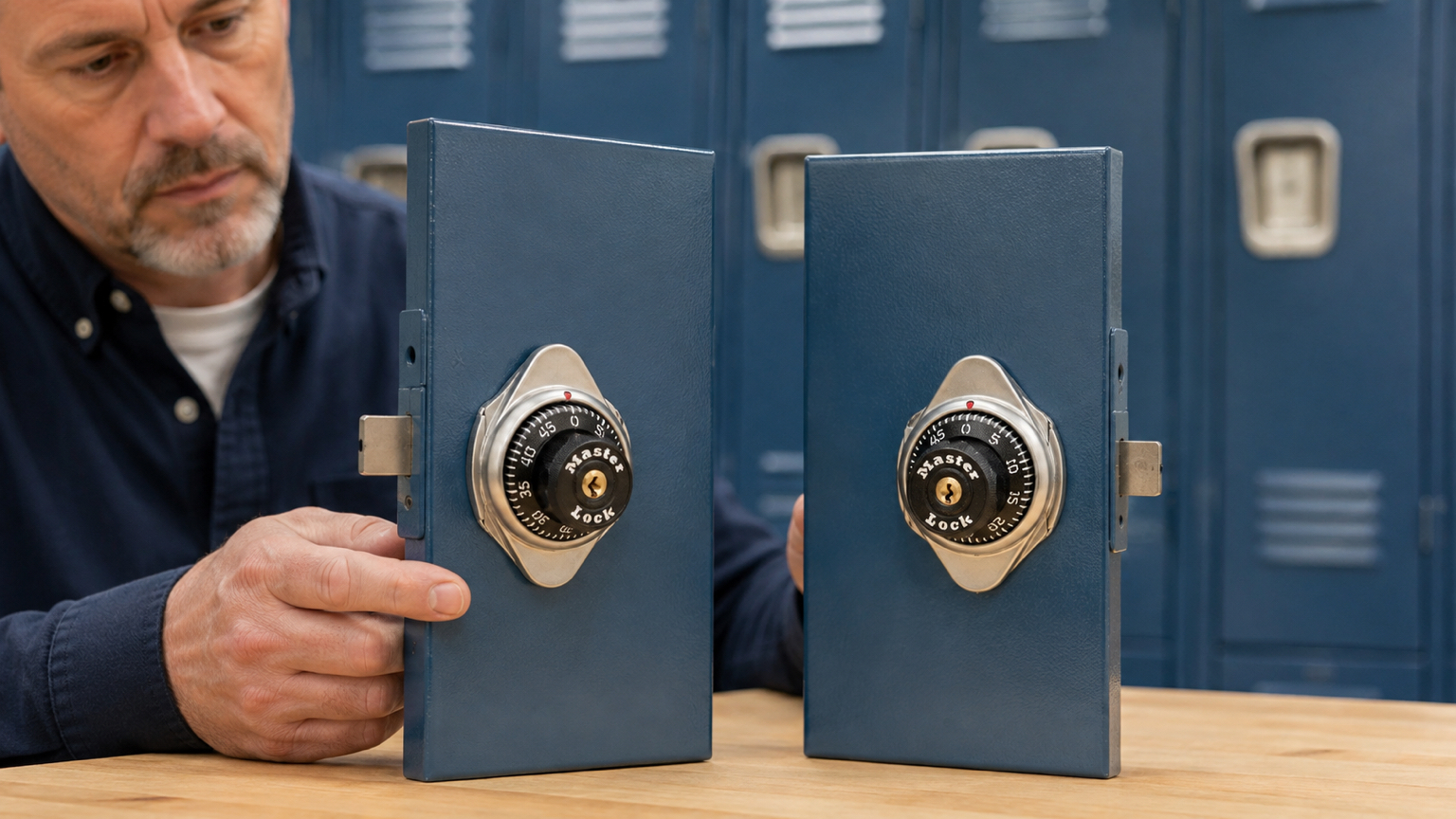
Short answer: choose the Master Lock 1652 for the manufacturer’s right-hinged standard single-point horizontal-latch application and the Master Lock 1653 for the corresponding left-hinged application. Both are built-in combination locks with automatic springbolt operation, but they are handed products. Confirm the locker’s hinge orientation, latch geometry, door preparation, and full existing model before treating either one as a replacement.
Key Takeaways
- The 1652 is the right-hinged member of this single-point horizontal-latch pair.
- The 1653 is the left-hinged member; it is not simply a 1652 installed backward.
- Master Lock describes both models as automatic springbolt built-in combination locks.
- Both use five manufacturer-provided preset combinations and have a nominal 1-7/8-inch body width.
- The 1652MD and 1653MD are metal-dial versions that retain their respective handing and application.
- “Single-point latch” is too broad for selection: horizontal-latch, wrap-around-latch, and box-lock applications are not interchangeable.
Master Lock 1652 vs. 1653 Comparison
| Selection factor | Master Lock 1652 | Master Lock 1653 |
|---|---|---|
| Manufacturer-listed handing | Right-hinged locker door | Left-hinged locker door |
| Primary application | Standard single-point horizontal-latch locker specified for the relevant handed model | |
| Locking mechanism | Automatic springbolt operation | |
| User operation | Three-number combination using five preset combinations identified by Master Lock | |
| Nominal body width | 1-7/8 inches on the current manufacturer pages | |
| Metal-dial designation | 1652MD | 1653MD |
| Selection rule | Use only after verifying the right-hinged 1652 application | Use only after verifying the left-hinged 1653 application |
The comparison describes the intended model families, not universal fit. Locker construction, mounting holes, latch engagement, door thickness, and condition must still be checked against current documentation.
Start With the Hinge Side
The central difference in a Master Lock 1652 vs. 1653 decision is handing. Master Lock associates the 1652 with a door hinged on the right and the 1653 with a door hinged on the left. Photograph the entire closed door from the aisle and label the opening so a reviewer can see the hinge side without relying on a written abbreviation.
Handing is more than where the hinges appear. The lock case, springbolt, mounting preparation, and horizontal latch relationship must work together. Do not rotate a right-hand model, rearrange parts, or infer a field modification. Use the model built and documented for the verified application.
Confirm the Horizontal-Latch Application
Both products are described for standard single-point horizontal-latch lockers. That wording separates them from other locks that also serve a single locking point. A rotating Wrap-Around-Latch locker belongs to a different application family, while a box or multiple-tier locker uses different rear hardware. The front dial alone cannot show which mechanism is behind the door.
Open the locker through the school’s authorized process and photograph the rear mechanism, horizontal latch, strike or frame engagement, and existing mounting points. Note interference, looseness, bending, or missing hardware. A lock selection should not be used to conceal a damaged door or latch that needs separate maintenance.
What the 1652 and 1653 Share
The Master Lock 1652 and Master Lock 1653 are closely matched in user operation. Master Lock identifies automatic springbolt locking, a three-number sequence, and five preset combinations for both. The current pages also list the same nominal body width.
These are institutional preset-combination locks, not consumer locks on which each user freely creates a new code. A school should maintain an authorized process for assigning lockers, protecting combination records, handling supervisory access, and documenting changes. Do not include combinations or unrestricted control information in a general quote request.
Base Models Versus Metal-Dial Variants
The 1652MD is the metal-dial version for the right-hinged application, and the 1653MD is the corresponding version for the left-hinged application. The MD suffix does not change the latch family, hinge side, body preparation, or compatibility requirements.
Record suffixes during a replacement survey instead of shortening every label to 1652 or 1653. That preserves the installed specification for review. A school can then discuss any proposed configuration change explicitly rather than allowing a dial difference to become an accidental substitution.
Avoid Confusing 1652/1653 With Other Numbered Models
Model numbers that are close numerically can serve different mechanisms. In particular, the 1654 and 1655 family is associated with box or multiple-tier locker applications, not the standard horizontal-latch application described for the 1652 and 1653. Read the Master Lock 1652 vs. 1654 comparison if the rear mechanism is unclear; after a box-locker application is confirmed, the Master Lock 1654 vs. 1655 guide addresses its hinge side.
Likewise, a wrap-around rotating latch is not identified by the broad phrase “single point” alone. Match the actual mechanism and locker preparation before selecting by model name, hinge side, or catalog photograph.
Separate New-Installation and Replacement Decisions
For an existing locker bank, begin with evidence from the installed hardware. A readable 1652 or 1653 label is useful, but it should be supported by photographs and measurements because doors, latches, or frames may have been altered over time. Record any units that differ from the surrounding bank instead of assuming one sample represents every opening.
For new lockers, coordinate the lock model with the locker manufacturer’s current preparation and the project hardware schedule before fabrication. A general requirement for a built-in combination lock does not specify handing or latch geometry. Keeping separate schedule rows for right-hinged 1652-type and left-hinged 1653-type applications makes the intended interface visible to the project team and creates a clear point for manufacturer confirmation.
Replacement Survey Checklist
- Complete existing lock model and suffix, with sensitive access information omitted.
- Locker manufacturer, series, door identifier, and any readable labels.
- Hinge side shown in a full closed-door photograph.
- Clear front and rear lock views plus the horizontal latch and frame engagement.
- Mounting preparation, door thickness, and relevant dimensions with a scale in view.
- Condition notes for the door, latch, strike, hinges, and connecting hardware.
- Separate quantities for verified 1652, verified 1653, MD variants, and uncertain units.
For unidentified openings, follow the replacement school locker lock identification guide. Confirmed families can also be reviewed in the built-in combination lock category.
Frequently Asked Questions
What is the main difference between Master Lock 1652 and 1653?
The 1652 is specified for the right-hinged standard horizontal-latch application; the 1653 is specified for the corresponding left-hinged application.
Can a 1652 replace a 1653?
Do not assume so. Their handing differs, and the complete locker preparation and mechanism must match the model selected.
Do the 1652 and 1653 lock automatically?
Master Lock’s current product pages describe automatic springbolt locking for both. Follow current instructions for the exact approved configuration.
What does MD mean on 1652MD or 1653MD?
MD identifies a metal-dial variant. The 1652MD remains right handed, and the 1653MD remains left handed for their specified applications.
Are the preset combinations user programmable?
Master Lock identifies five preset combinations. They should be managed through the school’s authorized records process rather than treated as user-created codes.
Is a 1654 the left-handed version of a 1652?
No. The corresponding left-handed horizontal-latch model is 1653. The 1654 belongs to a different box or multiple-tier application family.
What evidence is most useful for product selection?
Provide the full model, locker identity, hinge side, front and rear photographs, latch and frame views, measurements, condition notes, and quantities by verified configuration.
Product References
- Master Lock 1652 product specifications
- Master Lock 1653 product specifications
- Master Lock locker lock catalog
- Master Lock locker installation and maintenance resources
Get Help Matching the Hinge Side
If your school is comparing the 1652 and 1653 for a horizontal-latch locker bank, ask School Lock Supply for product-selection or quote help. Share the verified, non-sensitive mechanism and door details so each handed configuration can be reviewed accurately.