- Empty cart.
- Continue Shopping

Master Lock 1636MKADA vs. 1676MKADA vs. 1695MKADA: Which Locker Mechanism Fits?
- Posted on
marketang
- Categories: Locks for School Lockers
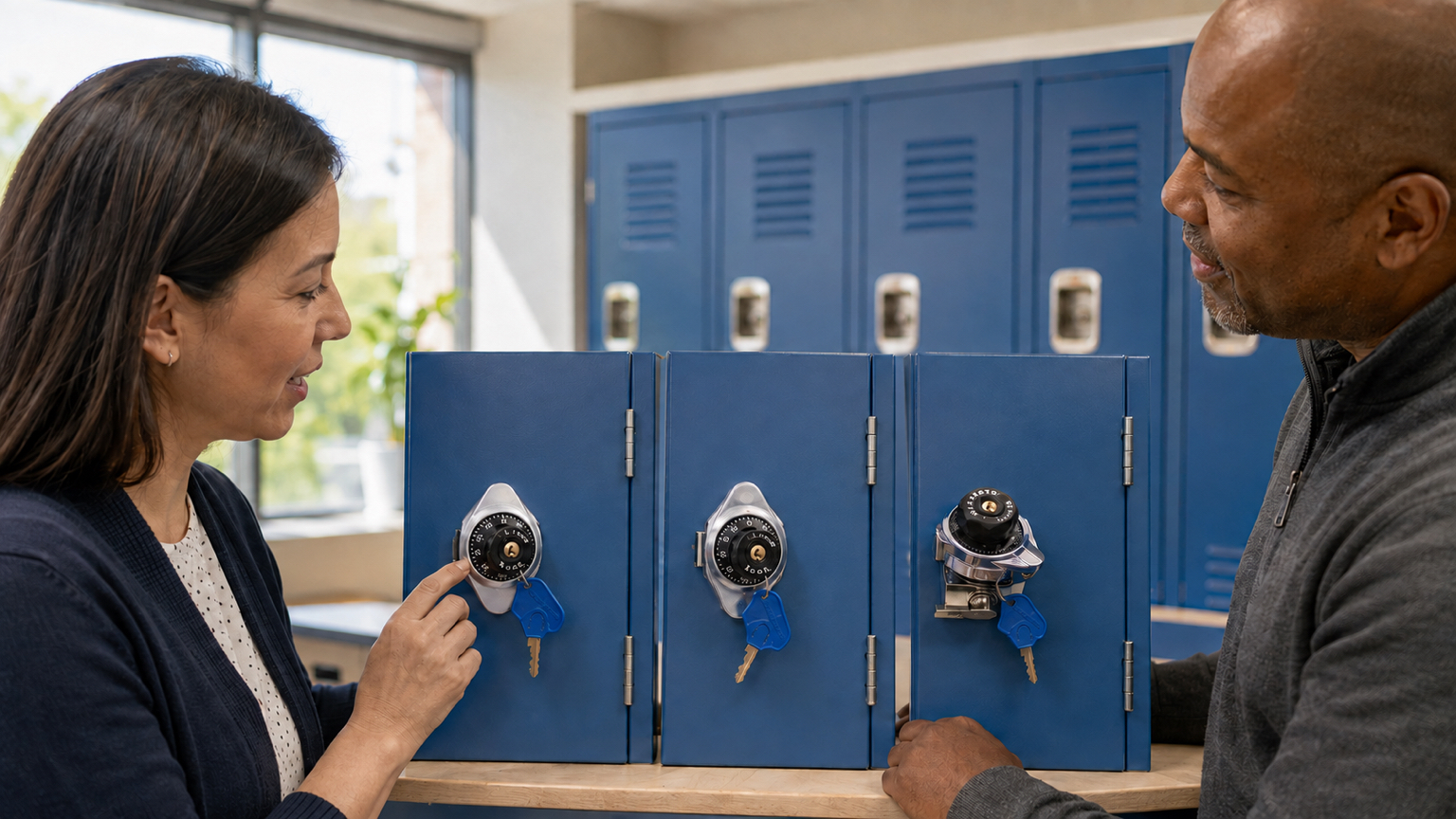
Short answer: choose among Master Lock 1636MKADA, 1676MKADA, and 1695MKADA by the locker mechanism first. Master Lock designates the 1636MKADA for a right-hinged lift-handle application with automatic locking, the 1676MKADA as a right-hinged manual-deadbolt model for several compatible locker styles, and the 1695MKADA for a right-hinged single-point Wrap-Around-Latch™ application with automatic locking. All three are manufacturer-designated ADA-compliant models, but a compliant product designation does not certify the complete installed locker or facility.
Key Takeaways
- Mechanism and locker preparation determine the model family; the ADA designation alone does not make the models interchangeable.
- 1636MKADA is associated with the right-hinged lift-handle application and automatic locking.
- 1676MKADA is a right-hinged manual-deadbolt model; Master Lock’s specification lists lift-handle, turn-handle, single-point-latch, and box-locker styles.
- 1695MKADA is associated with the right-hinged single-point Wrap-Around-Latch application and automatic locking.
- Master Lock describes three authorized ways to open each model: combination, student key, or master key.
- The whole locker installation must still be evaluated against the project’s applicable accessibility requirements.
ADA Locker Lock Model Comparison
| Selection factor | 1636MKADA | 1676MKADA | 1695MKADA |
|---|---|---|---|
| Manufacturer-listed application | Right-hinged lift-handle locker | Compatible right-hinged lift-handle, turn-handle, single-point horizontal-latch, or box locker | Right-hinged single-point Wrap-Around-Latch locker |
| Locking action | Automatic | Manual deadbolt | Automatic |
| Related standard application family | Comparable mechanism to 1630 | Comparable mechanism to 1670 | Comparable mechanism to 1690 |
| User and authorized access paths | Combination, student key, or master key as described by Master Lock | ||
| Combinations and dial | Five preset combinations; confirm dial material, color, and exact configuration rather than inferring them from the ADA suffix | ||
| What must be verified | Locker mechanism, hinge side, preparation, dimensions, condition, approved keying plan, and project accessibility criteria | ||
The table summarizes current manufacturer descriptions. It is not an installation approval or an accessibility determination for a particular project.
What the Three Models Share
Master Lock labels all three models ADA compliant and describes a key-controlled accessibility feature in addition to combination operation. Its current pages identify three ways to open the lock: the combination, a student key, or a master key. That access concept distinguishes these products from a conventional built-in combination lock that relies on the dial for regular user access.
The manufacturer identifies five preset combinations across the three pages and references metal-dial configurations or options. Dial material and color should still be confirmed for the exact model and suffix rather than assumed from the ADA designation. Those shared features do not erase the mechanism differences; the lock case and rear interface still have to correspond to the actual locker door.
These Three Models Are Right-Hand Configurations
All three models in this comparison are documented for doors hinged on the right when viewed from the front. They are not a selector for left-hinged openings. Master Lock lists the 1637MKADA as the left-hand lift-handle counterpart, but its current page marks it discontinued; the 1677MKADA is the left-hand manual-deadbolt counterpart. A left-hand project requires its own current status and compatibility review.
Choose 1636MKADA for the Specified Lift-Handle Application
The 1636MKADA is the automatic-locking option in this comparison for the manufacturer’s right-hinged lift-handle application. Master Lock describes it as operating like the 1630 model while adding the ADA-designated key-controlled access feature. That comparison is useful for identifying the mechanism, not for approving a conversion without measurements and current documentation.
Photograph the full door, lift handle, rear lock case, linkage, mounting points, and frame components. Verify right-hand orientation and the locker preparation. If an existing unit has a different model or suffix, preserve that information for review rather than reducing the description to “lift handle.”
Choose 1676MKADA for the Specified Manual-Locking Application
The 1676MKADA uses manual deadbolt locking and is compared by Master Lock with the 1670 family. Its current product title names lift-handle and single-point horizontal-latch lockers, while the manufacturer’s architectural specification also lists turn-handle and box-locker styles. These descriptions are application categories, not a promise of universal fit. Manual locking means the user’s required closing and locking workflow differs from the automatic models, so the mechanism and the school’s operating expectations both matter.
Do not select 1676MKADA merely because the locker is right hinged or because older literature uses a broad phrase such as “all locker styles.” Confirm the exact locker, preparation, rear interface, door thickness, and latch engagement against current manufacturer and locker-maker information. The 1690-style Wrap-Around-Latch application belongs to the separate 1695MKADA family in this comparison.
Choose 1695MKADA for the Specified Wrap-Around-Latch Application
The 1695MKADA is the automatic-locking model for the manufacturer’s right-hinged single-point Wrap-Around-Latch application. Master Lock compares its mechanism with the 1690 family. A wrap-around latch rotates around its mating plate; it should not be confused with the standard horizontal latch merely because each secures one point.
Include photographs of the rotating latch, latch plate, back of the installed lock, full door, and hinge side. Confirm that the locker manufacturer’s preparation matches the documented 1695MKADA application. Apparent similarity at the front of the door is not enough to establish fit.
ADA-Designated Product Does Not Equal a Compliant Installation
The phrase “manufacturer-designated ADA compliant” accurately describes how Master Lock presents these models. It should not be expanded into a promise that every locker using one will comply. Reach range, mounting height, clear floor space, approach, door force, operable parts, surrounding construction, applicable code edition, and project-specific requirements can all affect the finished installation.
Master Lock uses “ADA-compliant” for these built-in locker locks and separately uses “ADA-inspired” for certain portable locks intended to address physical or cognitive needs. Those labels are not interchangeable. A product described as ADA-inspired should not be represented as meeting the same standard as a manufacturer-designated ADA-compliant built-in model.
Have the responsible architect, accessibility professional, authority having jurisdiction, or other qualified project reviewer determine what applies. Use the ADA-compliant vs. ADA-inspired locker lock guide for terminology, and browse the ADA-compliant lock category without treating a category listing as project certification.
Plan Mixed Locker Banks by Verified Opening
A project may contain more than one locker mechanism even when every door looks similar from the aisle. Survey each distinct bank and keep lift-handle, horizontal-latch, and wrap-around-latch quantities separate. If only selected openings are part of an accessibility scope, identify those locations through the approved project schedule rather than choosing them informally during product ordering.
The reviewer should also confirm that the specified lock, locker, mounting location, door operation, and surrounding space work together. Product selection can support that coordinated design, but it cannot decide how many accessible lockers are required, where they belong, or whether completed construction meets the governing criteria.
Pre-Selection Survey Checklist
- Applicable project specification, code criteria, and responsible accessibility reviewer.
- Locker manufacturer, series, door identifier, and complete existing lock designation.
- Full closed-door photograph showing hinge location and installation context.
- Rear views showing lift-handle linkage, horizontal latch, or wrap-around latch.
- Mounting preparation, door thickness, latch engagement, and relevant measurements.
- Whether the intended workflow calls for automatic or manual locking.
- Approved user-key and supervisory-key requirements, without sending sensitive key data publicly.
- Quantity separated by verified mechanism and any openings that still need review.
Frequently Asked Questions
What is the main difference among 1636MKADA, 1676MKADA, and 1695MKADA?
They address different locker mechanisms and locking actions: automatic lift handle, a manual-deadbolt model for several compatible right-hand locker styles, and automatic Wrap-Around-Latch, respectively.
Which model matches the automatic right-hinged lift-handle application?
Master Lock identifies the 1636MKADA for that application. Confirm the lift-handle linkage, handing, preparation, dimensions, and current locker-manufacturer guidance.
Can one locker bank require more than one of these models?
Yes. Renovation phases or differing door constructions can create multiple mechanisms within one facility. Count each verified lift-handle, horizontal-latch, and wrap-around-latch configuration separately.
Which model is for a wrap-around rotating latch?
Master Lock identifies the 1695MKADA for its right-hinged single-point Wrap-Around-Latch application. Verify the actual latch and preparation.
Which of these models uses manual locking?
The 1676MKADA is described with manual deadbolt operation. The 1636MKADA and 1695MKADA are described as automatic-locking models.
Does the MKADA designation make the rear mechanisms interchangeable?
No. The shared designation does not change the lock case, bolt action, handing, latch interface, or door preparation. Select by the verified locker application.
What should a school document before requesting a model review?
Document the project criteria, locker and existing-lock identities, hinge side, rear mechanism, preparation, measurements, locking workflow, approved keying needs, condition, and quantity by configuration.
Product References
- Master Lock 1636MKADA product specifications
- Master Lock 1676MKADA product specifications
- Master Lock 1695MKADA product specifications
- Master Lock 1676MKADA and 1677MKADA architectural specification
- Master Lock ADA locker lock information
- U.S. Department of Justice 2010 ADA Standards for Accessible Design
- Master Lock architect and locker design resources
Get Help Matching the ADA-Designated Model
If your school has confirmed project accessibility criteria and needs help matching the locker mechanism, ask School Lock Supply for product-selection or quote help. Share non-sensitive specifications, photographs, measurements, handing, workflow, and quantity by application for review.