- Empty cart.
- Continue Shopping

Master Lock 1652 vs. 1654: Single-Point Latch vs. Box Locker Locks
- Posted on
marketang
- Categories: Locks for School Lockers
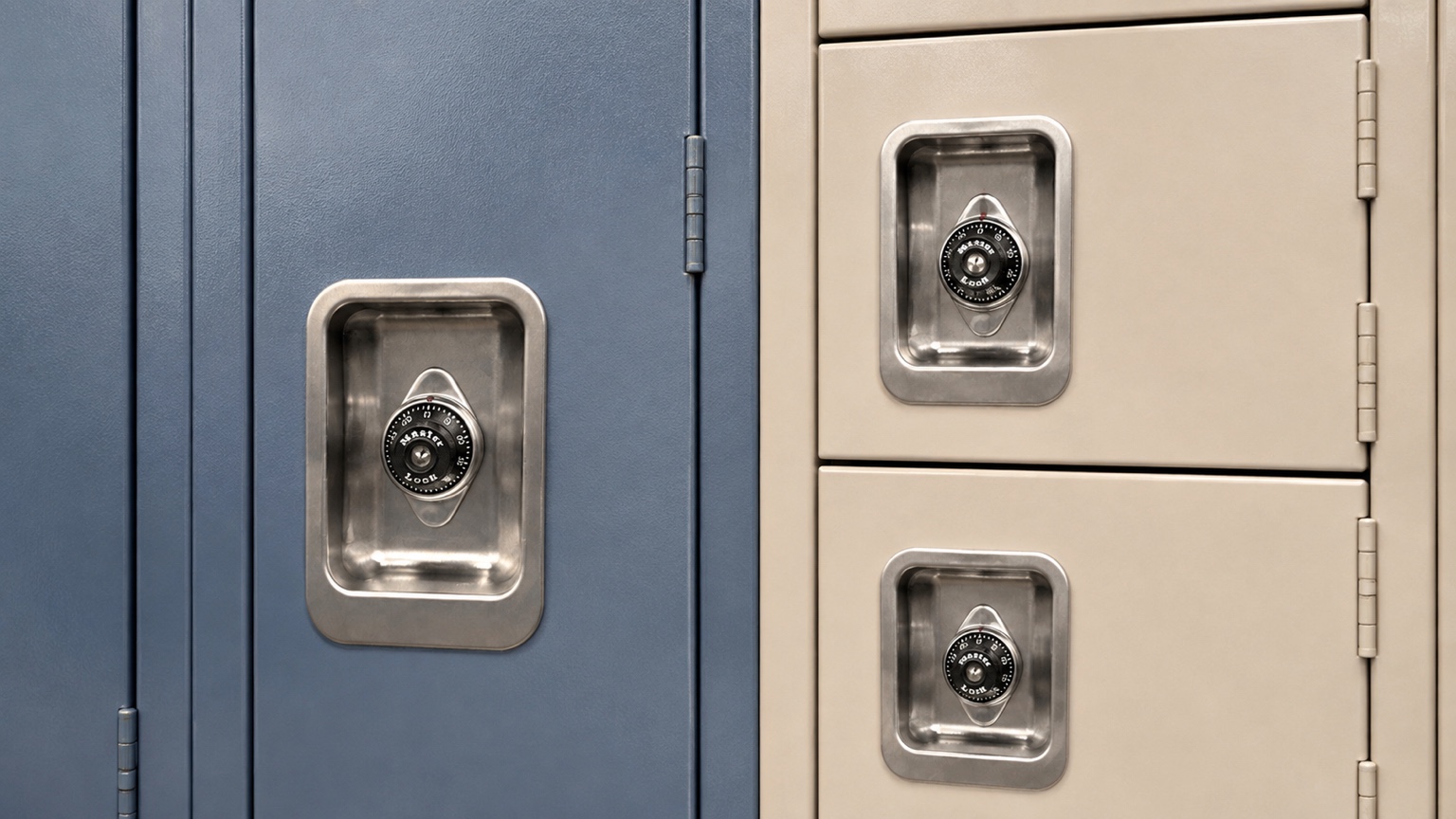
Short answer: choose the Master Lock 1652 for a standard right-hinged single-point horizontal-latch locker. Choose the Master Lock 1654 for a right-hinged horizontal-latch box or multiple-tier locker. Both are built-in combination locks with automatic springbolt action, but their bolts and intended locker mechanisms are different.
Key Takeaways
- The 1652 and 1654 are not interchangeable simply because both use a built-in combination dial.
- The 1652 is designed for standard single-point horizontal-latch lockers and has an extra-long, fully retractable bolt.
- The 1654 is designed for horizontal-latch box or multiple-tier lockers and uses a standard-length bolt.
- Both right-hand models use automatic springbolt locking and have five preset combinations.
- The 1653 is the left-hand counterpart to the 1652; the 1655 is the left-hand counterpart to the 1654.
- Correct selection requires hinge orientation, latch photographs, rear-mechanism details, and door measurements.
Master Lock 1652 vs. 1654 Comparison
| Selection factor | Master Lock 1652 | Master Lock 1654 |
|---|---|---|
| Intended locker | Standard single-point horizontal-latch locker | Horizontal-latch box or multiple-tier locker |
| Hinge orientation | Right | Right |
| Locking action | Automatic springbolt | Automatic springbolt |
| Bolt distinction | Extra-long, fully retractable bolt | Standard-length horizontal bolt |
| Combination-change design | Buttonless process performed from outside with the proper control key | Use the official procedure for the 1654 series |
| Left-hand counterpart | 1653 | 1655 |
The manufacturer’s locker descriptions are the starting point. The locker make, door preparation, latch geometry, alignment, and existing parts still need to be checked before ordering.
Choose the 1652 for a Single-Point Horizontal Latch
The Master Lock 1652 is a right-hand built-in combination lock for a standard single-point horizontal-latch locker. Master Lock highlights its extra-long, fully retractable bolt. That longer bolt is part of the model’s intended interaction with this specific latch application.
The 1652 also uses automatic springbolt action. When a compatible, correctly adjusted locker door closes, the mechanism can engage without the user performing a separate manual deadbolt step. Students should still check the door after closing it; automatic locking describes the mechanism, not a guarantee that a damaged or misaligned door latched successfully.
Choose the 1654 for a Box or Multiple-Tier Locker
The Master Lock 1654 is the right-hand model for horizontal-latch box lockers. Master Lock literature also describes the 1654 series as appropriate for box or multiple-tier lockers with pull or friction-latch handles. Its horizontal springbolt retracts into the lock body and automatically engages in the intended application.
Do not identify a 1654 from locker height alone. A short door may use several possible handle and latch designs. Photograph the inside hardware and confirm the latch style instead of assuming every box locker requires the same lock.
Why Bolt Length and Latch Geometry Matter
The visible combination dial does not show the most important compatibility difference. Behind the door, the bolt must travel in the correct direction and reach the locker’s latch point without binding. The 1652’s extra-long bolt is intended for its single-point horizontal-latch application, while the 1654’s standard-length bolt is intended for a box-locker mechanism.
A lock that physically mounts through the same opening may still be unsuitable if the bolt does not engage correctly. Door wear, bent hardware, accumulated paint, loose hinges, and latch misalignment can also affect operation. Inspect the locker condition before treating a lock replacement as the only repair needed.
The 1652 Buttonless Combination-Change Process
Master Lock redesigned the 1652 family with a buttonless combination-change process. Authorized staff use the proper control key and dial steps from the outside of the locker, without opening the door to press a rear-case button. The design is intended to reduce accidental combination changes caused by items pressing a button inside an overfilled locker.
This operational difference can matter to facilities teams managing many lockers. It does not mean the lock accepts any user-selected combination. The 1652 has five manufacturer-provided preset combinations, and staff advance among them using the official process and corresponding control information.
The 1654 also has five preset combinations, but staff should follow Master Lock’s procedure for that model rather than assuming the 1652 buttonless steps apply. Model-specific instructions prevent accidental changes and administrative record errors.
Right-Hand and Left-Hand Model Pairs
The 1652 and 1654 discussed here are right-hand models. Face the closed locker: hinges on the right indicate a right-hand opening. For left-hand doors, School Lock Supply lists the Master Lock 1653 for the 1652-style single-point latch application and the Master Lock 1655 for the 1654-style box-locker application.
Handing and latch type are separate decisions. “Right hand” does not tell you whether the locker needs a 1652 or 1654; it only narrows the orientation after the mechanism has been identified.
Shared School Administration Features
Both model families are built-in three-number combination locks. Master Lock says they provide five preset combinations, end-user registration, and control charts to help manage assignments. Standard key control supports authorized combination changes and supervisory access.
Control-key capability does not mean every key opens every lock. Registered systems protect key-system integrity, and matching an existing system requires the correct authorized information. Do not assume keys or other accessories are included in a School Lock Supply quote; ask for each component to be identified.
Schools comparing more built-in models can browse the built-in combination locker lock category.
What to Include in a Model-Selection Request
- Full photographs of the closed locker door, hinges, handle, and latch.
- Clear photographs of the lock’s rear case and bolt in locked and unlocked positions.
- The current manufacturer and model number, if known.
- Right- or left-hand opening while facing the closed door.
- Door thickness and any extension parts already in use.
- Whether replacements must match an existing registered control-key system.
- The requested quantity and whether the project is a replacement or new installation.
Frequently Asked Questions
What is the main difference between Master Lock 1652 and 1654?
The 1652 is designed for a standard single-point horizontal-latch locker and uses an extra-long bolt. The 1654 is designed for a horizontal-latch box or multiple-tier locker and uses a standard-length horizontal bolt.
Do both models lock automatically?
Yes. Master Lock specifies springbolt action for automatic locking on both models when installed in a compatible, correctly functioning locker.
Can a 1654 replace a 1652?
Do not assume it can. The bolts and intended latch applications differ. Confirm the existing rear mechanism, door preparation, alignment, and manufacturer compatibility.
What are the left-hand versions?
The 1653 corresponds to the 1652 single-point-latch family for a left-hinged door. The 1655 corresponds to the 1654 box-locker family for a left-hinged door.
Can students choose their own combinations?
No. These institutional locks use five preset combinations. Authorized staff manage changes using the appropriate control-key process and control chart.
Does the 1654 use the 1652 buttonless change process?
Do not apply the 1652 procedure to another model. Follow Master Lock’s current instructions for the exact lock being serviced.
Is a control key included with the lock?
Do not assume package contents. Request a quote that separately identifies the lock models, required control keys, control-chart information, and any installation accessories.
Continue the Selection Process
Use the broader replacement school locker lock identification guide when the hinge, latch, rear mechanism, or existing model is unclear. For a district-wide count, transfer each confirmed configuration to the bulk locker-lock pre-quote checklist.
Product References
- Master Lock 1652 product specifications
- Master Lock 1654 product specifications
- Master Lock locker installation and administration guidance
Get Help Choosing the Correct Latch Model
If the rear mechanism is unclear, do not guess between the 1652 and 1654. Ask School Lock Supply for product-selection or quote help and include photographs, hinge orientation, current model details, door measurements, quantity, and existing control-key information.