- Empty cart.
- Continue Shopping

Master Lock 1654 vs. 1655: Box-Locker Locks by Hinge Side
- Posted on
marketang
- Categories: Locks for School Lockers
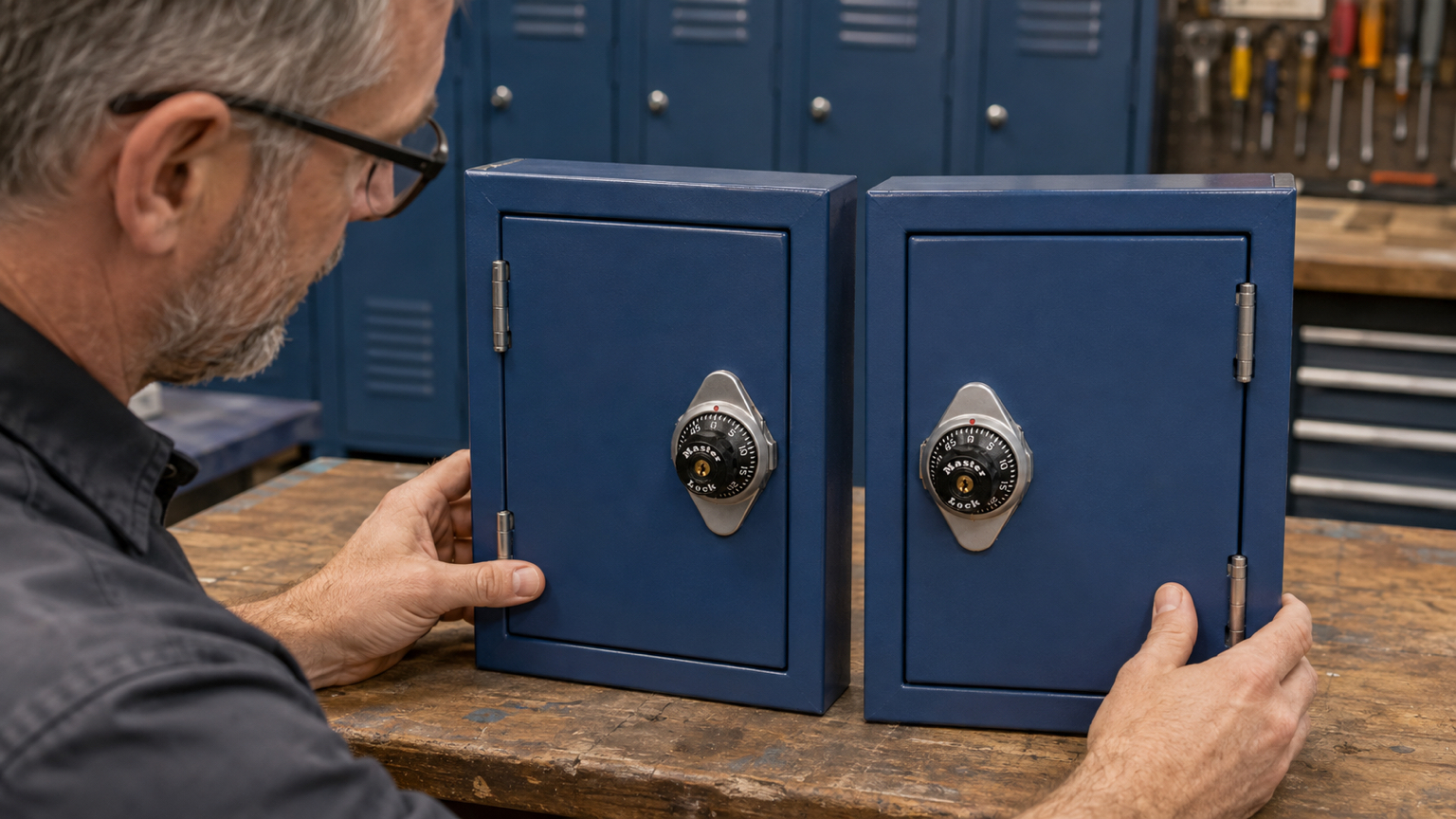
Short answer: choose the Master Lock 1654 for a compatible horizontal-latch box or multiple-tier locker with hinges on the right. Choose the Master Lock 1655 for the corresponding application with hinges on the left. Both are automatic-springbolt built-in combination locks; hinge side is the headline difference, but the horizontal latch, mounting, door preparation, thickness, and condition still have to match.
Key Takeaways
- The 1654 is the right-hand model; the 1655 is the left-hand model in this box-locker family.
- Determine handing while facing the closed locker: hinges right means right-hand, and hinges left means left-hand.
- Master Lock’s current pages identify both models for standard horizontal-latch box lockers.
- The manufacturer’s 1654 Series architectural specification also identifies the family for box and multiple-tier lockers.
- Both use a horizontal springbolt designed to lock automatically on door closure.
- The 1654MD remains right-handed; its MD distinction is a metal dial, not a different hinge orientation.
- Verify the latch, mounting, door thickness, alignment, existing system, and quoted components before ordering.
Master Lock 1654 vs. 1655 Comparison
| Selection factor | Master Lock 1654 | Master Lock 1655 |
|---|---|---|
| Hinge orientation | Right-hand | Left-hand |
| Manufacturer-listed locker type | Horizontal-latch box locker; 1654 Series specification also covers multi-tier applications | Horizontal-latch box locker; 1654 Series specification also covers multi-tier applications |
| Locking action | Horizontal springbolt; automatic locking | Horizontal springbolt; automatic locking |
| Combination format | Three-digit dial with five preset combinations | Three-digit dial with five preset combinations |
| Current standard page | 1654 right-hand configuration | 1655 left-hand configuration |
| Metal-dial direction | 1654MD is the right-hand metal-dial model | Master Lock’s series specification identifies 1655MD as the left-hand metal-dial model |
This is an application summary, not a promise that either model fits every short locker door. Confirm the complete mechanism instead of choosing by locker height or hinge side alone.
How to Determine Locker Hinge Side
Use Master Lock’s viewpoint: stand in front of the closed locker. Hinges on the right make it a right-hand opening; hinges on the left make it a left-hand opening. Under that definition, the Master Lock 1654 is the right-hand selection and the Master Lock 1655 is the left-hand selection.
Photograph the entire closed door with the hinges visible, then photograph the rear mechanism with the door open. These two views prevent a common communication error: describing the hinge side from behind the open door and reversing the intended model.
Confirm a Horizontal-Latch Box or Multiple-Tier Application
The current 1654 and 1655 product pages say the locks are designed for standard horizontal-latch box lockers. Master Lock’s official 1654 Series architectural specification describes four models—1654, 1655, 1654MD, and 1655MD—for multi-tier and box lockers. It specifies a horizontal operating springbolt mounted in a compatible single-point-latch locker.
Do not use “box locker” as a measurement-only category. A short compartment may have a different handle, latch travel, or lock preparation. Identify the horizontal latch and observe where the existing bolt engages. If the old hardware is missing, use the locker manufacturer and current compatibility documentation rather than guessing from the door shape.
Both Models Use Automatic Springbolt Locking
The 1654 and 1655 share their basic operating concept. Master Lock specifies springbolt action for convenient automatic locking. In a compatible, correctly adjusted installation, the horizontal springbolt is designed to engage when the door closes, without the user turning the dial as a separate relocking step.
Automatic locking is a mechanism description, not proof that a particular door latched. Paint buildup, a bent door, loose hinges, worn handle parts, or an out-of-position strike can interfere with engagement. Repair those conditions and have users check the door after closing it.
Do Not Confuse 1654 vs. 1655 With 1652 vs. 1654
The 1654-versus-1655 decision separates right- and left-handed versions of the box-locker family. The 1652-versus-1654 decision separates two right-hand latch applications: Master Lock identifies the 1652 for a standard single-point horizontal-latch locker with an extra-long, fully retractable bolt, while the 1654 uses the standard-length box-locker bolt.
A right-hinged door therefore does not automatically need a 1654. First confirm that the locker is in the box or multiple-tier application, then choose 1654 or 1655 by handing. See the Master Lock 1652 versus 1654 comparison when the latch family is uncertain. Once a standard horizontal-latch application is confirmed instead, use the Master Lock 1652 vs. 1653 handing guide.
What the 1654MD Changes
The Master Lock 1654MD is a right-hand built-in combination lock for the same horizontal-latch box-locker direction. Its defining MD feature is the metal dial. Master Lock says that metal dial provides increased strength and security.
The suffix does not change the hinge rule: 1654MD is right-hand. Master Lock’s series specification identifies 1655MD as the left-hand metal-dial model. If dial material is part of the project requirement, document it independently from locker handing and confirm the exact quoted model.
Shared Combination and Administration Features
Master Lock’s current pages describe the 1654 and 1655 as three-digit built-in combination locks with five preset combinations, end-user registration, and control charts. The manufacturer also identifies standard key control for authorized changes and supervisory access. Those features support institutional administration, but they should be managed under school policy.
Do not assume a control key, extension set, colored dial, or any other accessory is included in a School Lock Supply quote. Ask for the proposal to name each model and component. No combination-change procedure or sensitive control information is needed in a public-facing selection request.
Door Thickness and Extension Sets
Both current product pages identify an extension kit for locker doors from 11/16 inch (17 mm) through 3/4 inch (19 mm) thick. Master Lock’s installation guidance includes the 1654 and 1655 among the combination locks supported by that extension set.
This does not mean every project needs an extension or that an extension solves another mismatch. Measure the actual door, note any existing extension hardware, and confirm the latch and mounting first. Have the quote list a required extension set separately.
Box-Locker Verification Checklist
- Photograph the closed door with hinges and handle visible.
- Record right- or left-hand opening from the front of the locker.
- Photograph the inside horizontal latch, lock case, bolt, mounting points, and strike.
- Identify the locker manufacturer and current lock model when available.
- Confirm that the application is a compatible box or multiple-tier locker, not merely a short door.
- Measure door thickness and record any extension parts already present.
- Flag damage, paint buildup, loose hinges, and alignment problems for correction.
- State whether a standard or metal dial and an existing control-key system must be matched.
When several locker banks differ, build a line-item count by confirmed configuration. Mixed right- and left-hand openings should not be combined under a single unspecific “box-locker lock” quantity. More options are organized in the built-in combination lock category.
Frequently Asked Questions
What is the main difference between Master Lock 1654 and 1655?
The 1654 is for a compatible right-hinged horizontal-latch box-locker application. The 1655 is the left-hand counterpart. Their automatic springbolt operation and core administration features are otherwise closely aligned.
How do I identify a right-hand locker?
Face the closed locker. If the hinges are on the right, Master Lock defines it as right-hand. Hinges on the left indicate a left-hand opening.
Are 1654 and 1655 for multiple-tier lockers?
Master Lock’s official 1654 Series specification identifies the family for multi-tier and box lockers. The horizontal latch, mounting, door preparation, and manufacturer compatibility still need verification.
Do the 1654 and 1655 lock automatically?
Yes. Master Lock specifies horizontal springbolt action for automatic locking on door closure in the intended installation. Door condition and alignment can still affect engagement.
Is the 1654MD a left-hand version of the 1654?
No. The 1654MD is also right-hand; MD identifies its metal dial. Master Lock’s series specification identifies 1655MD as the left-hand metal-dial configuration.
Can a 1655 replace a 1654 if the locks look alike?
No direct substitution should be assumed. They serve opposite hinge orientations. Verify handing, latch geometry, mounting, thickness, and door condition before naming the replacement.
Is an extension set included for a thick door?
Do not assume it is included. Master Lock lists an extension option for specified 17–19 mm doors, but School Lock Supply should identify any required extension components in the quote.
Continue the Identification Process
If the model, latch, or mounting cannot be confirmed, use the replacement school locker lock identification guide. A complete photo set is more useful than a close-up of the dial because it shows the handing and rear mechanism together.
Product References
- Master Lock 1654 current product specifications
- Master Lock 1655 current product specifications
- Master Lock 1654MD current product specifications
- Master Lock 1654 Series architectural specification
- Master Lock handing, extension, and locker terminology guidance
Get Help Matching the Box-Locker Handing
Ask School Lock Supply for product-selection or quote help. Include front and rear photographs, hinge side, horizontal-latch details, current model, door thickness, condition, quantity by configuration, dial preference, and existing control-system requirements.