- Empty cart.
- Continue Shopping

Master Lock 1690 Guide for Wrap-Around-Latch School Lockers
- Posted on
marketang
- Categories: Locks for School Lockers
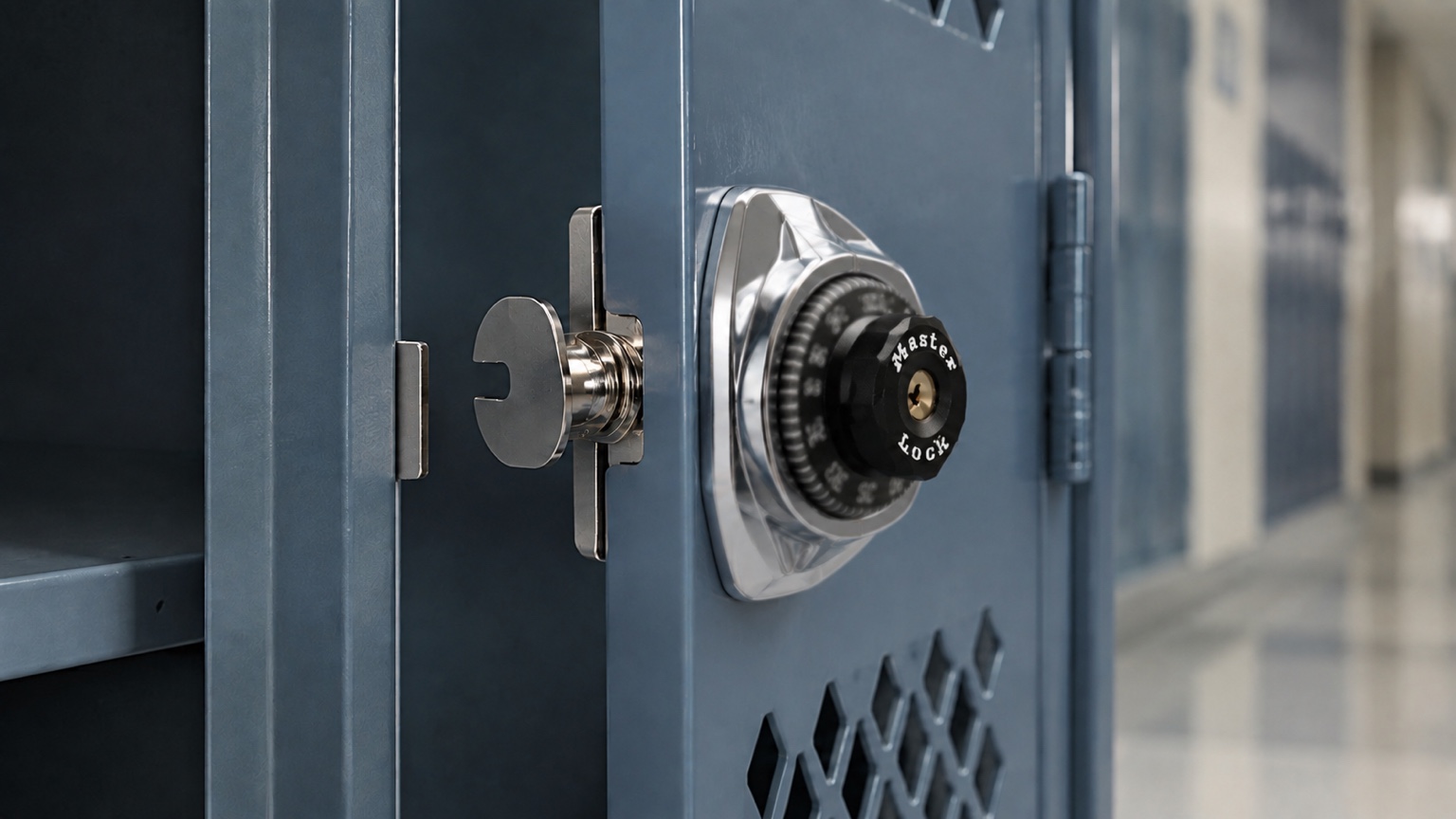
Short answer: the Master Lock 1690 is a built-in, three-digit combination locker lock made for right-hinged lockers that use a single-point wrap-around-latch mechanism. It uses automatic deadbolt locking, provides five preset combinations for authorized reassignment, and supports system-specific key control for supervisory access and combination changes. It should be selected only after the school confirms the locker’s hinge and latch design.
Key Takeaways
- The Master Lock 1690 is designed for right-hinged, single-point wrap-around-latch lockers.
- Its rotating latch wraps around the locker’s stationary latch plate or post and uses automatic deadbolt locking.
- Students operate the lock with a three-digit combination.
- The lock has five preset combinations that authorized staff can change using the correct chart and system-specific key procedure.
- The control key is system-specific and supports supervisory access and authorized combination changes; no key should be assumed to be included with a quote.
Master Lock 1690 Compatibility at a Glance
| Decision point | Master Lock 1690 | What the school should verify |
|---|---|---|
| Product format | Built-in combination locker lock | The project requires a permanently installed lock |
| Door orientation | Locker hinged on the right | Confirm while facing the closed locker door |
| Latch application | Single-point wrap-around-latch mechanism | Inspect the interior latch, plate, or post |
| Locking behavior | Automatic deadbolt locking | Confirm this behavior matches the school’s operating plan |
| User credential | Three-digit combination | Establish a secure assignment process |
| Reassignment | Five preset combinations | Maintain the correct chart and authorized change process |
| Staff administration | System-specific control key for supervisory access and combination changes | Identify the registered system and required keys separately |
These characteristics distinguish the model, but they do not replace a physical compatibility check. Similar dials can appear on locks made for different locker mechanisms.
What Is a Wrap-Around-Latch Locker?
A wrap-around-latch locker uses a rotating latch that closes around a stationary latch plate or post. Master Lock describes the 1690 as a built-in lock for single-point, 1690-style rotating-latch applications. The model is intended for lockers hinged on the right.
The key phrase is single point: one latch engagement secures the door. That differs from lockers that use a lift handle or another multi-point mechanism. It also differs from a conventional padlock-eye application. A school should inspect the hardware behind the door rather than identify the lock only from its front dial.
When documenting a replacement, photograph the full closed door, the exterior lock face, and the interior latch area. Keep combinations, control charts, student information, and key numbers out of the images.
How the Automatic Deadbolt Works
Master Lock states that the 1690 uses automatic deadbolt locking. As the door closes, the rotating latch wraps around the stationary plate or post and secures the single-point engagement. The manufacturer describes the design as able to tolerate some locker misalignment; that tolerance may reduce alignment-related adjustment within an otherwise verified 1690 application.
That does not mean the lock can correct damaged locker hardware. Bent doors, loose hinges, worn latch plates, or incorrect mounting can interfere with operation. During installation or inspection, test the complete door-and-lock cycle rather than operating the lock while the door is open.
Automatic locking also affects school procedures. Staff should confirm that the door closes and locks as intended and that users understand they may need the assigned combination after the door shuts. The school should not select automatic behavior without considering its locker-assignment and support process.
Three-Digit Operation and Five Preset Combinations
The 1690 uses a three-digit combination for normal user access. It is an institutional preset-combination lock, not a consumer lock on which each student invents a personal code. Master Lock provides five preset combinations so an authorized facility can move to another assigned combination during the lock’s service life.
A school should maintain the manufacturer-issued control chart securely and record which preset is active without exposing combinations to unrelated staff or students. When a locker is reassigned, authorized staff should follow the exact Master Lock instructions and verify the lock afterward. Do not attempt to derive combinations or use unofficial reset methods.
Five preset combinations do not mean five people use the locker at once. They are administrative options for controlled changes over time. The school remains responsible for deciding when a change is appropriate and for updating its restricted records.
Supervisory Access and Combination Changes
Master Lock describes standard key control on the 1690 for supervisory access and combination changes. The correct key must correspond to the school’s lock system. It is not a universal key, and a key from another building or product family should not be tested as a substitute.
Before requesting replacements, determine whether the new locks must relate to an existing registered system. Record the exact model and available non-sensitive system reference, then have an authorized facilities contact handle any protected chart or key information.
Never assume the applicable control key comes with the Master Lock 1690. The school should ask the quote to identify locks, keys, charts, extensions, and any other requested items separately.
How to Confirm a 1690 Application
- Verify the existing model. Record every number and suffix visible on the installed lock or approved hardware schedule.
- Confirm the hinge side. The standard 1690 application is a locker hinged on the right.
- Inspect the latch. Confirm a single rotating latch wraps around a stationary latch plate or post.
- Check the mounting area. Look for prior modifications, loose fasteners, door damage, or extension hardware.
- Measure relevant door conditions. Master Lock identifies an extension option for certain thicker doors; document actual thickness rather than assuming it is needed.
- Identify administration requirements. Note the registered system, chart custody, supervisory access, and combination-change process without sending sensitive details broadly.
- Test a verified configuration. Confirm normal opening, closing, automatic locking, and supervisory operation on the actual locker before expanding the project.
1690 vs. Other Built-In Combination Locks
The 1690 belongs to a broader group of Master Lock built-in combination locker locks. Other models serve lift-handle, conventional single-point-latch, manual-deadbolt, or different hinge applications. Choosing among them begins with the locker mechanism, not with a preference for one model number.
If a current lock has a similar dial but a different latch behind the door, do not treat the 1690 as a direct replacement. Likewise, a portable combination padlock is not a substitute for a built-in lock unless the locker was designed with a suitable padlock eye and the school intentionally changes its access plan.
Accessibility Requires a Separate Model Decision
The standard 1690 should not be relabeled as an accessible model. Master Lock directs buyers who need an ADA application in this wrap-around-latch family to its manufacturer-designated 1695MKADA series. The project team should review the exact accessible configuration and installation context rather than assuming a dial style or key feature establishes compliance.
Keep standard and accessible quantities on separate lines in a quote request. This makes the intended models, locations, and operating methods clear during review.
1690 Pre-Quote Checklist
- Right-hinged locker confirmed
- Single-point rotating wrap-around latch confirmed
- Exact current model and suffix recorded
- Door condition, mounting, and thickness documented
- Quantity counted by configuration and building
- Existing registered-system relationship identified
- Control-key requirements for supervisory access and combination changes listed separately
- Accessibility needs separated into the correct manufacturer-designated model review
- Non-sensitive exterior and interior photos prepared
Frequently Asked Questions
What locker type is the Master Lock 1690 designed for?
It is designed for right-hinged lockers with a single-point wrap-around-latch, also described by Master Lock as a 1690-style rotating-latch application.
Does the Master Lock 1690 lock automatically?
Yes. Master Lock specifies automatic deadbolt locking. The complete locker door and latch should still be inspected and tested for correct operation.
How many digits are in a 1690 combination?
The user operates the lock with a three-digit combination.
Can a student choose a new combination?
No. The 1690 uses five manufacturer-preset combinations. Changes are an authorized administrative task performed with the correct chart, key, and model-specific instructions.
Is the control key included with the lock?
Do not assume that it is. Keys and other administrative items should be identified explicitly in the School Lock Supply quote, and the key must match the applicable system.
Can the 1690 replace any built-in school locker lock?
No. It is application-specific. Verify hinge orientation, latch mechanism, mounting, door condition, and registered-system requirements before selecting it.
Is the standard 1690 an ADA-compliant model?
The standard 1690 is not the manufacturer-designated ADA model in this family. Master Lock identifies the 1695MKADA series for ADA applications; confirm the exact project requirements and installation.
Continue the Selection Process
If the latch does not match this application, use the replacement locker-lock identification guide and compare the Master Lock 1630 and 1670 locking actions. For the related accessible application, review the separate ADA-compliant vs. ADA-inspired guide.
Official Master Lock References
- Master Lock 1690 product specifications
- Master Lock built-in combination-change instructions
- Master Lock locker design resources
Get Help Confirming a Master Lock 1690
School Lock Supply can help review whether the 1690 matches a school’s right-hinged wrap-around-latch locker and identify the information needed for a quote. Request product-selection assistance with the exact current model, quantity, hinge and latch details, non-sensitive photos, and any registered-system requirement.