- Empty cart.
- Continue Shopping

Master Lock 1710, 1714, or 1790? Built-In Keyed Locker Lock Guide
- Posted on
marketang
- Categories: Locks for School Lockers
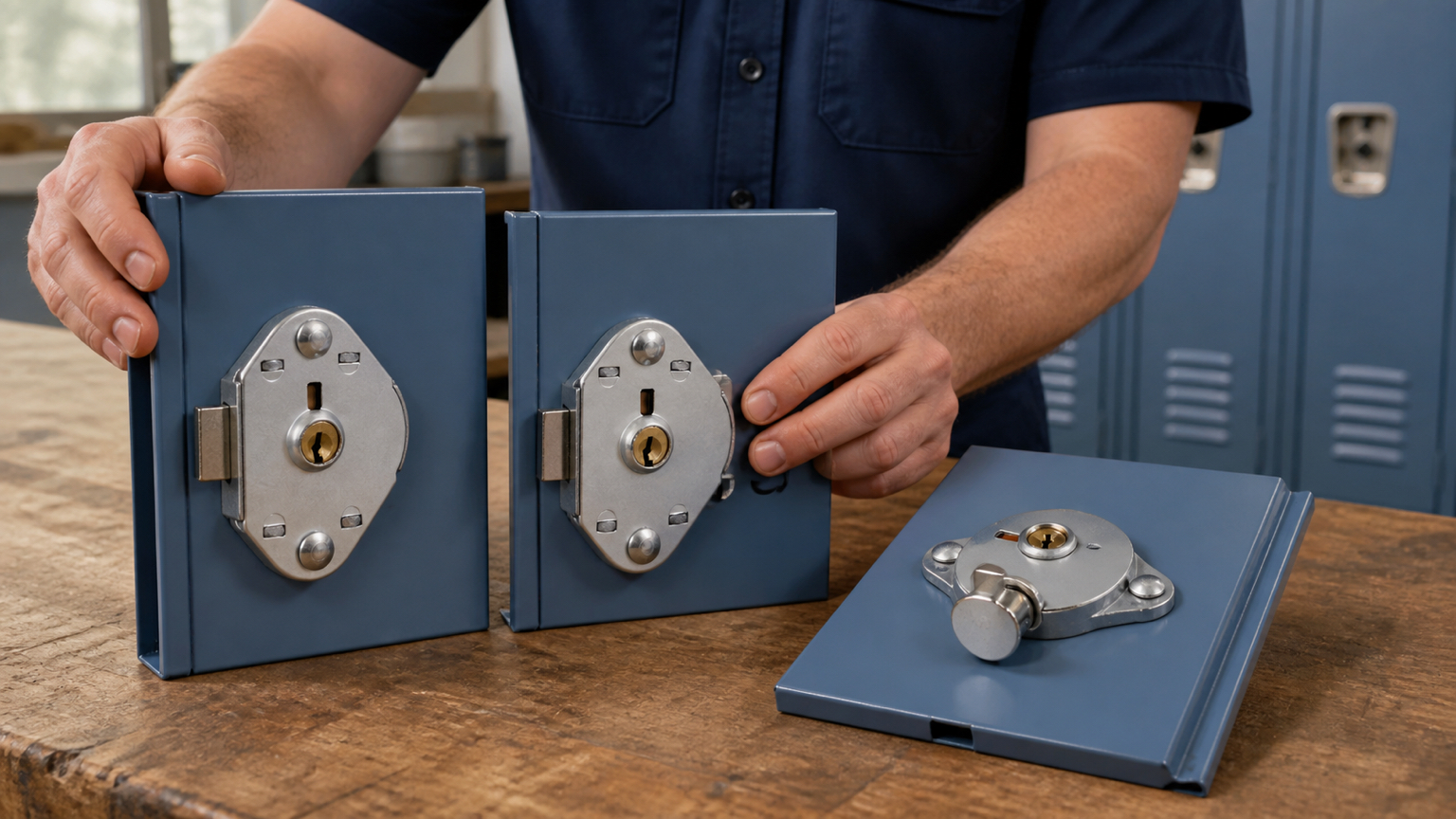
Short answer: choose the Master Lock 1710 when a compatible lift-handle, single-point horizontal-latch, or box locker needs manual deadbolt locking; choose the 1714 when the same manufacturer-listed locker types need automatic springbolt locking, especially a box-locker application. Choose the 1790 only for a compatible single-point rotating Wrap-Around-Latch™ locker. The correct built-in keyed locker lock depends first on the latch, mounting, handing, and desired locking action—not on the lock face alone.
Key Takeaways
- The 1710 and 1714 share several listed locker applications, but the 1710 is a manual deadbolt and the 1714 is an automatic springbolt.
- Master Lock specifically describes the 1710 as ideal for ventilated and open-mesh lockers.
- Master Lock describes the 1714 as ideal for box lockers and directs open-mesh applications to the 1710.
- The 1790 is a different mechanism for single-point rotating Wrap-Around-Latch lockers and uses automatic deadbolt locking.
- The 1710 and 1714 fit both left- and right-hinged doors; Master Lock installation material identifies the standard 1790 as right-hand.
- Confirm the locker manufacturer, latch, door preparation, mounting, handing, thickness, alignment, and keying plan before requesting a quote.
Master Lock 1710, 1714, and 1790 Comparison
| Selection factor | Master Lock 1710 | Master Lock 1714 | Master Lock 1790 |
|---|---|---|---|
| Manufacturer-listed application | Lift handle, single-point horizontal latch, and box lockers | Lift handle, single-point horizontal latch, and box lockers; especially box lockers | Single-point rotating Wrap-Around-Latch lockers |
| Locking action | Manual deadbolt | Automatic springbolt | Automatic deadbolt |
| Door handing | Left or right | Left or right | Standard model identified as right-hand in manufacturer instructions |
| Notable application direction | Manufacturer’s open-mesh and ventilated-locker direction | Manufacturer says to use 1710 for open mesh | Designed around the rotating wrap-around latch |
| Cylinder and keying | 5-pin cylinder; manufacturer-listed institutional keying options | 5-pin cylinder; manufacturer-listed institutional keying options | 5-pin cylinder; manufacturer-listed institutional keying options |
These are manufacturer specifications, not a universal interchange chart. A model can match a broad locker description and still be wrong for the actual door preparation or latch geometry.
Start With the Locker Mechanism
A product photo is a weak basis for choosing among these locks because the decisive parts sit behind the door. Photograph the handle, the complete latch path, the existing lock case, and the way the bolt meets the mechanism. Record the locker manufacturer and current lock model when those markings are available.
The Master Lock 1710 and Master Lock 1714 are both listed for standard lift-handle, single-point horizontal-latch, and box lockers. That overlap does not make them interchangeable: the locking action is different. The Master Lock 1790 belongs to the rotating Wrap-Around-Latch application instead.
Choose the 1710 for Manual Deadbolt Operation
The 1710 requires the user to operate the manual deadbolt. That deliberate action is the principal operational difference from the 1714. Master Lock describes the concealed steel-case lock as fitting both left- and right-hinged doors and identifies it for indoor school, employee, and health-club applications.
The current manufacturer page also calls the 1710 ideal for ventilated and open-mesh lockers. That statement is useful application guidance, but it is not permission to skip a fit check. An open-mesh door can still have the wrong latch, altered mounting holes, excessive wear, or another incompatible construction detail.
Choose the 1714 for Automatic Springbolt Operation
The 1714 uses springbolt action for automatic locking and is described by Master Lock as providing slam-shut convenience. It also fits both left- and right-hinged doors in its intended applications. Master Lock highlights box lockers and expressly says that an open-mesh locker should use the 1710.
“Automatic” describes how the springbolt is intended to engage; it does not guarantee that every closed door has locked. Bent doors, loose hinges, a dragging handle, or a misaligned latch can prevent proper engagement. Schools should repair the locker and teach users to check the door after closing it.
Choose the 1790 for a Rotating Wrap-Around Latch
The 1790 is purpose-built for a single-point rotating Wrap-Around-Latch locker. Master Lock specifies automatic deadbolt locking and describes the patented latch design as supporting slam-shut operation. The manufacturer also says the design is intended to tolerate locker misalignment, but that does not make serious door or latch defects acceptable.
Do not substitute a 1790 merely because automatic locking is preferred. First confirm the rotating latch and door preparation. Master Lock installation material identifies the standard 1790 as right-hand, determined while facing the closed door. This is a meaningful difference from the universal handing stated for the 1710 and 1714. If the mechanism is confirmed but the user credential is still open, compare the 1690 combination and 1790 keyed Wrap-Around-Latch options.
Compare User Workflow Without Ranking Security by Mechanism
Manual and automatic mechanisms create different closing routines. A 1710 user deliberately operates the deadbolt. A compatible 1714 or 1790 is designed to engage through its automatic action. That workflow question matters in student orientation and daily supervision, but it should not be turned into an unsupported claim that one model is categorically “more secure” than another.
Master Lock currently places all three product pages in its High Security level. The application, correct installation, locker condition, key control, and user behavior all affect the finished result.
Plan the Cylinder and Keying Structure Separately
Each current product page specifies a 5-pin tumbler cylinder and lists keyed-different, master-keyed, and group-key options. Keyed-alike product configurations also exist. These terms describe who can operate which cylinders; they do not change an incompatible latch into a compatible one.
Product-page key references should not be used to infer the contents of a School Lock Supply proposal. Have the quote enumerate lock configurations, user-key requirements, any separately required administrative keys, extension parts, and other requested components. Browse the built-in keyed lock category to compare the listed configurations.
Pre-Quote Verification Checklist
- Photograph the locker front, hinge side, handle, inside latch, current lock case, and bolt engagement.
- Identify a lift handle, horizontal latch, box-locker mechanism, or rotating Wrap-Around-Latch.
- State whether the desired routine is manual deadbolt or automatic locking.
- Record handing while facing the closed door and note any mixed configurations.
- Measure door thickness and identify existing spacers or extension hardware.
- Flag damaged, painted, loose, or misaligned doors and latches for repair.
- Describe the required keyed-different, keyed-alike, group-keyed, or master-keyed administration plan.
Frequently Asked Questions
What is the main difference between Master Lock 1710 and 1714?
The 1710 uses manual deadbolt locking, while the 1714 uses an automatic springbolt. Both have several manufacturer-listed locker applications, so choose by both physical fit and the required operating routine.
Which model does Master Lock recommend for an open-mesh locker?
Master Lock describes the 1710 as ideal for ventilated and open-mesh lockers. Its 1714 page specifically directs an open-mesh application to the 1710. Compatibility still needs to be verified.
When should a school consider the 1790?
Consider the 1790 when the locker uses the compatible single-point rotating Wrap-Around-Latch mechanism. Do not select it solely because the school wants automatic operation.
Are the 1710 and 1714 left- or right-handed?
Master Lock says both models fit left- and right-hinged doors. Its installation documentation identifies the standard 1790 as right-hand, so record hinge orientation before specifying that model.
Do the 1710, 1714, and 1790 use one universal key?
No universal-key assumption should be made. Master Lock lists multiple institutional keying configurations, and the required user and administrative access structure must be specified for the exact system. Have the proposal list the requested components.
Can a 1714 replace a 1710 without changing anything else?
Do not assume so. The models use different locking actions, and the locker manufacturer, latch, mounting, door preparation, alignment, and intended workflow must all be confirmed.
Does a manufacturer compatibility listing guarantee the finished installation?
No. Master Lock says its compatibility program does not guarantee specific security or durability standards and tells purchasers to conduct their own evaluation before purchase. The complete application still needs review.
Continue the Selection Process
For more detail on the administrative choice, read the keyed alike versus master keyed locker-lock guide. If the current model or rear mechanism is unclear, use the replacement school locker lock identification guide before naming a model.
Product References
- Master Lock 1710 current product specifications
- Master Lock 1714 current product specifications
- Master Lock 1790 current product specifications
- Master Lock 1700 Series installation instructions
- Master Lock Lock-Locker Compatibility Program details
Get Help Selecting a Built-In Keyed Lock
Ask School Lock Supply for product-selection or quote help. Send clear locker and latch photographs, current model information, handing, door thickness, quantity, operating preference, and keying requirements so the 1710, 1714, or 1790 application can be reviewed without guessing.