- Empty cart.
- Continue Shopping

ADA-Compliant vs. ADA-Inspired Locker Locks: What Schools Need to Know
- Posted on
marketang
- Categories: Locks for School Lockers
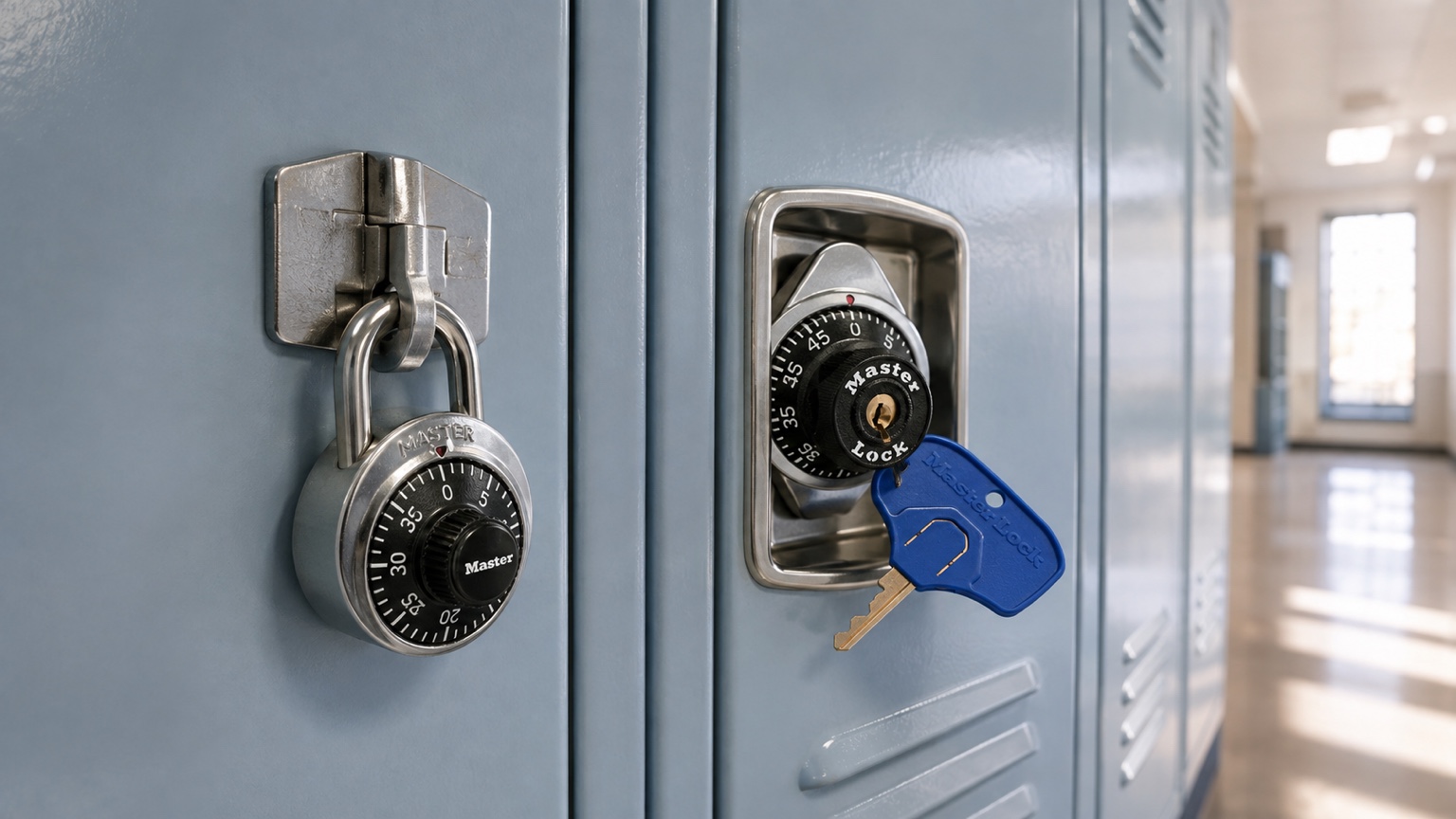
Short answer: Master Lock describes the portable 1525EZRC as ADA Inspired, not ADA compliant. It identifies the built-in 1636MKADA, 1676MKADA, and 1695MKADA as ADA-compliant locker locks. Those labels are not interchangeable, and selecting a manufacturer-designated ADA-compliant lock does not by itself establish that the complete locker installation or facility complies with applicable accessibility requirements.
Key Takeaways
- Use Master Lock’s exact designation: 1525EZRC is ADA Inspired.
- Master Lock designates 1636MKADA, 1676MKADA, and 1695MKADA as ADA compliant.
- The 1525EZRC is a portable combination padlock; the three ADA-compliant models are built-in locker locks with three opening methods.
- The built-in models serve different locker door, handle, latch, and locking-action applications, so model numbers are not interchangeable.
- Accessibility depends on the complete installation, including locker selection, placement, approach, operable parts, surrounding space, and project requirements.
ADA-Compliant vs. ADA-Inspired Master Lock Models
| Model | Manufacturer designation | Lock format | Primary selection distinction |
|---|---|---|---|
| 1525EZRC | ADA Inspired | Portable preset-combination padlock | Simplified dial reading for users who have difficulty remembering combinations but not dexterity challenges |
| 1636MKADA | ADA compliant | Built-in combination lock | Automatic locking for compatible right-hinged, lift-handle lockers |
| 1676MKADA | ADA compliant | Built-in combination lock | Manual deadbolt for compatible right-hinged lift-handle and specified latch styles |
| 1695MKADA | ADA compliant | Built-in combination lock | For compatible right-hinged, single-point Wrap-Around-Latch™ lockers |
This table reflects Master Lock’s product descriptions. A project team still needs to verify the exact locker construction and the accessibility requirements that apply to the complete installation.
Why the Terminology Matters
“ADA Inspired” and “ADA compliant” sound similar, but Master Lock uses them for different product groupings. Treating the terms as synonyms can lead a school to specify the wrong lock format or to overstate what a single component establishes.
Master Lock separates its ADA-compliant built-in locker locks, which provide Three-Ways-To-Open operation, from its ADA Inspired portable locker locks. Use the manufacturer’s wording in purchasing records, project schedules, and stakeholder communications. When a project has a formal accessibility scope, ask the responsible accessibility professional to review the entire assembly and installation. This article is product-selection guidance, not legal advice.
What “ADA Inspired” Means for the 1525EZRC
The Master Lock 1525EZRC is a portable, preset three-number combination padlock. Master Lock describes it as ADA Inspired and says it is designed for users who have difficulty remembering combinations but do not have dexterity challenges. Its Simple Combos™ program uses only the numbers printed on the dial, without sub-increments between those numbers, to simplify reading and entering the assigned sequence.
The 1525EZRC remains part of the institutional 1525 format. Master Lock lists a 1-7/8-inch (48 mm) body, 3/4-inch (19 mm) shackle, BlockGuard® Anti-Shim Technology, automatic scrambling, and a supervisory control-key feature. It attaches to compatible locker hardware as a portable padlock rather than being mounted inside the door.
The simplified combination format addresses one defined use case. It should not be described as a substitute for a manufacturer-designated ADA-compliant built-in lock when a project requires that category.
How the ADA-Compliant Built-In Models Differ
The 1636MKADA, 1676MKADA, and 1695MKADA share Master Lock’s Three-Ways-To-Open approach. A user can open the locker with an ADA-keyhead student key, an authorized supervisor can use the applicable master-key system, or a user can enter the assigned combination. Master Lock lists two ADA-keyhead student keys and five preset combinations with these models; master keys are handled separately.
That shared operation does not make the three lock bodies interchangeable. Their locking action and intended locker hardware differ.
1636MKADA: automatic locking for lift-handle lockers
Master Lock identifies the 1636MKADA for compatible right-hinged, lift-handle lockers. Its automatic-locking action follows the 1630 family: closing the door returns the locker to a secured state according to the installed mechanism. Confirm door handing, handle construction, mounting preparation, and compatibility with the locker manufacturer.
1676MKADA: manual deadbolt operation
Master Lock identifies the 1676MKADA as the ADA-compliant counterpart in the 1670-style manual-deadbolt family. Its listed applications include compatible right-hinged lift-handle lockers, single-point horizontal-latch lockers, and nonrotating latch styles. The user must move the locking mechanism as intended rather than relying on automatic locking.
1695MKADA: Wrap-Around-Latch locker application
Master Lock identifies the 1695MKADA for compatible right-hinged, single-point Wrap-Around-Latch lockers. It is the ADA version associated with the 1690 family. A familiar face or similar overall size is not enough to establish fit; verify the precise door and latch preparation.
Why the Lock Alone Does Not Establish Compliance
A manufacturer-designated ADA-compliant lock is one component of a locker installation. The finished result also depends on which lockers are designated for accessible use, where their operable parts are located, whether an accessible approach and clear floor area are provided, and whether surrounding benches, doors, walls, or stored items interfere with use. Project-specific codes, adopted standards, contracts, and authority requirements may also matter.
Hardware compatibility is part of the same review. A lock intended for a right-hinged lift-handle door cannot simply be transferred to a different latch style because both are called “built-in locker locks.” Likewise, an accessible opening method does not correct an otherwise unreachable or obstructed installation.
Schools should have the project’s architect, accessibility consultant, locker manufacturer, or other qualified professional confirm the complete design. Keep the manufacturer’s current product documents with the submittal record, and avoid turning a component label into a claim about the whole room or facility.
A Product-Selection Checklist
- Record whether the project calls for a portable padlock or a built-in locker lock.
- Use the exact manufacturer designation—ADA Inspired or ADA compliant—in project documents.
- Identify door handing, handle type, latch style, locking action, and mounting preparation.
- Confirm whether the school needs student key access, combination access, and supervisory master-key access.
- Determine how student keys, master keys, and combination records will be issued and controlled.
- Have the responsible project professional review placement, reach, approach, clear space, and the complete installed assembly.
- Verify the exact model against current manufacturer documents before approval.
If the existing locker is already installed, provide clear front, side, and interior-door photos with visible model markings. If it is a new locker package, coordinate the lock selection with the locker manufacturer rather than treating it as a late accessory substitution.
Frequently Asked Questions
Is the Master Lock 1525EZRC ADA compliant?
Master Lock describes the 1525EZRC as ADA Inspired, not ADA compliant. Its Simple Combos format is intended for users who have difficulty remembering combinations but do not have dexterity challenges.
Which right-hand built-in combination models are covered in this guide?
This guide covers the right-hand built-in combination models 1636MKADA, 1676MKADA, and 1695MKADA, which Master Lock identifies as ADA compliant. Each serves a specified locker-hardware application that must be verified. Master Lock also publishes additional ADA models for other handing and lock formats.
What are the three ways to open the ADA-compliant built-in models?
Master Lock describes opening by an ADA-keyhead student key, the applicable supervisory master-key system, or the preset combination.
Are the 1636MKADA, 1676MKADA, and 1695MKADA interchangeable?
No. They differ in locking action and compatible locker door, handle, and latch applications. Confirm the exact locker construction and mounting preparation.
Does installing an ADA-compliant lock make the whole locker installation compliant?
No single lock establishes the compliance of the complete installation. Placement, approach, clear floor area, reach to operable parts, compatible hardware, and applicable project requirements must also be evaluated.
Who should confirm accessibility for a school locker project?
The school should coordinate with the qualified professional responsible for the project, such as its architect or accessibility consultant, and with the locker manufacturer. Product literature supports that review but does not replace it.
Continue the Selection Process
Use the replacement locker-lock identification guide to document the actual door and latch before selecting a model. For mixed standard and accessible configurations, keep each quantity separate in the bulk school locker-lock checklist.
Official Product References
- Master Lock ADA-compliant built-in locker lock overview
- Master Lock ADA Inspired locker lock overview
- Master Lock 1525EZRC product specifications
- Master Lock 1636MKADA specifications, 1676MKADA specifications, and 1695MKADA specifications
Get Help Organizing the Locker-Lock Requirements
Review the broader School Lock Supply shop, then request product-selection or quote help with the locker manufacturer, door and latch details, photos or drawings, quantities, and required opening methods. Final accessibility determinations should remain with the qualified professional responsible for the complete project.