- Empty cart.
- Continue Shopping

Master Lock 1630 vs. 1670: Automatic Locking or Manual Deadbolt?
- Posted on
marketang
- Categories: Locks for School Lockers
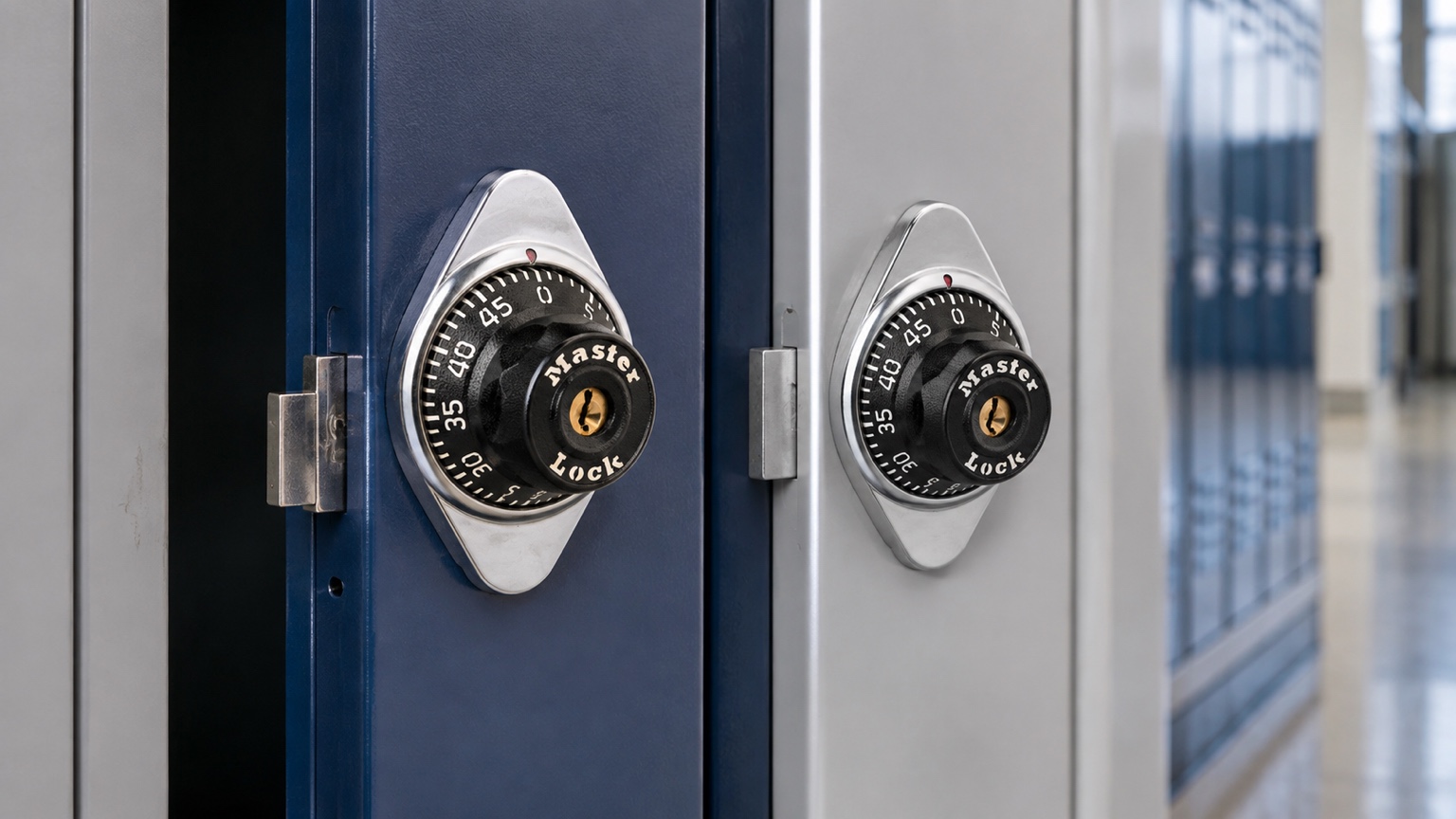
Short answer: the Master Lock 1630 is designed for a standard right-hinged lift-handle locker and locks automatically when the locker mechanism closes. The Master Lock 1670 fits several right-hinged locker styles and uses a manual deadbolt, so the user must turn the dial to relock it. Choose by locker hardware and desired locking action—not by appearance alone.
Key Takeaways
- The 1630 is a built-in combination lock for standard lift-handle lockers with hinges on the right.
- The 1670 supports right-hinged lift-handle, turn-handle, single-point horizontal-latch, and box-locker applications identified by Master Lock.
- The 1630 locks automatically; the 1670 uses a manual deadbolt that requires the dial to be turned to relock the door.
- Both offer five preset combinations, a control-chart system, and control-key functionality for authorized administration.
- A school should verify hinge side, handle or latch type, door condition, and access to the back of the lock before ordering.
Master Lock 1630 vs. 1670 Comparison
| Selection factor | Master Lock 1630 | Master Lock 1670 |
|---|---|---|
| Primary locker hardware | Standard lift handle | Lift handle, turn handle, single-point horizontal latch, or box locker |
| Hinge orientation | Right | Right |
| Locking action | Automatic | Manual deadbolt |
| Bolt movement | Vertical travel engages lift-handle mechanism | Horizontal deadbolt action |
| Preset combinations | Five | Five |
| Best starting point | Standard lift-handle locker needing automatic relocking | Compatible locker needing deliberate manual relocking |
This table summarizes manufacturer classifications. A model still needs to be checked against the specific locker make, handle or latch geometry, hinge side, door thickness, and condition.
Choose the 1630 for a Standard Lift-Handle Locker
The Master Lock 1630 is purpose-built for standard lift-handle lockers with hinges on the right as the user faces the closed locker. Its locking bolt travels vertically to engage the lift-handle mechanism. Master Lock describes the model as automatically locking, which means the user does not perform a separate manual deadbolt step after closing the locker.
That narrow compatibility statement is important. A round combination dial on the front does not establish that a lock is a 1630 or that a replacement 1630 will fit. Facilities staff should examine the handle and the mechanism behind the door, then confirm the locker manufacturer or compatibility documentation where available.
Choose the 1670 for Manual Deadbolt Operation
The Master Lock 1670 has broader manufacturer-listed applications: lift-handle, turn-handle, single-point horizontal-latch, and box lockers with hinges on the right. It uses a manual deadbolt. Master Lock explains that the dial must be turned to relock the door.
The 1670 can be useful for mesh or ventilated lockers where the rear of the lock is accessible, but that statement should not be converted into a claim that it fits every mesh locker. The actual latch position, door preparation, hinge orientation, and bolt engagement still need to match.
Automatic Locking vs. Manual Relocking
What automatic locking changes
With the 1630, the locker mechanism engages the lock as the door and lift handle return to the locked position. This can simplify the closing action for students, but staff should still teach users to check the door after closing it. “Automatic” describes the mechanism; it does not replace a physical check that the door latched correctly.
What a manual deadbolt changes
With the 1670, closing the door is not the final locking step. The user turns the dial to engage the deadbolt. A school selecting this model should include that action in student instructions and orientation. The deliberate step may suit a compatible application, but it also makes correct user training especially important.
Shared Administration Features
Both models are built-in, three-number combination locks with five preset combinations. Master Lock provides control-chart administration and identifies standard key control for combination changes and supervisory access. The key system and combination records should be handled as restricted administrative information.
Five preset combinations do not mean students can invent any five combinations. Authorized staff move the lock among its manufacturer-provided combinations using the correct procedure and control-key system. Master Lock publishes model-specific instructions and videos; facilities teams should follow those resources rather than an unverified third-party shortcut.
For a broader view of available models, visit the built-in combination lock category.
Hinge Side and Door Thickness Still Matter
Master Lock defines locker handing from the front: when facing the closed door, hinges on the right indicate a right-hand opening. Both the 1630 and 1670 discussed here are right-hand models. A visually similar left-hand door requires a corresponding left-hand configuration, so hinge orientation should be recorded before a quote is requested.
The manufacturer also lists an extension kit for certain thicker doors. Master Lock says the kit enables specified built-in combination locks, including 1630 and 1670, to operate in standard locker doors from 11/16 inch (17 mm) through 3/4 inch (19 mm) thick. This does not mean every installation needs a kit. Measure the door and confirm the complete application first.
Replacement Checklist
- Photograph the front of the locker, the handle or latch, and the rear lock mechanism.
- Record visible lock model, locker manufacturer, and any system markings.
- Confirm right- or left-hand opening while facing the closed locker.
- Identify lift handle, turn handle, horizontal latch, box locker, or another mechanism.
- Note whether the current lock relocks automatically or requires a manual dial turn.
- Measure door thickness and describe any extension hardware already installed.
- Identify whether replacements must align with an existing registered control-key system.
Frequently Asked Questions
Does the Master Lock 1630 lock automatically?
Yes. Master Lock identifies the 1630 as an automatic-locking built-in model for standard right-hinged lift-handle lockers.
Does the Master Lock 1670 lock automatically?
No. It uses a manual deadbolt. After closing the locker, the user must turn the dial to engage the lock.
Can the 1670 replace a 1630?
Do not assume that it can. Although Master Lock lists lift-handle applications for the 1670, bolt action, door preparation, locker construction, and intended operation must all be checked before changing models.
How do I tell whether a locker is right-handed?
Face the closed locker door. If the hinges are on the right, Master Lock considers it a right-hand opening. Record the orientation from this viewpoint.
Do both models have changeable combinations?
Each has five manufacturer-provided preset combinations. Authorized staff can advance among them using the proper control key and official model instructions; they are not consumer set-your-own locks.
Is a control key included with either model?
Do not infer package contents from the product feature. Ask for the quote to identify locks, control keys, control charts, and other components separately.
Are accessible versions available?
Master Lock identifies model 1636MKADA for the 1630 application and 1676MKADA for the 1670 application. Confirm the complete locker installation and use the manufacturer’s exact accessibility designation; a lock alone does not establish compliance for the whole installation.
Continue the Selection Process
If the existing mechanism is uncertain, follow the replacement school locker lock identification guide before choosing a model. Schools with a rotating single-point latch can compare the separate Master Lock 1690 application guide.
Product References
- Master Lock 1630 product specifications
- Master Lock 1670 product specifications
- Master Lock installation, handing, and locker-lock terminology
Get Help Matching the Lock to the Locker
If your school is choosing between the 1630 and 1670, ask School Lock Supply for product-selection or quote help. Include photographs, hinge orientation, handle or latch type, current model information, quantity, and any existing control-key details so the application can be reviewed accurately.