- Empty cart.
- Continue Shopping

Master Lock 1690 vs. 1790: Combination or Keyed Wrap-Around-Latch Lock?
- Posted on
marketang
- Categories: Locks for School Lockers
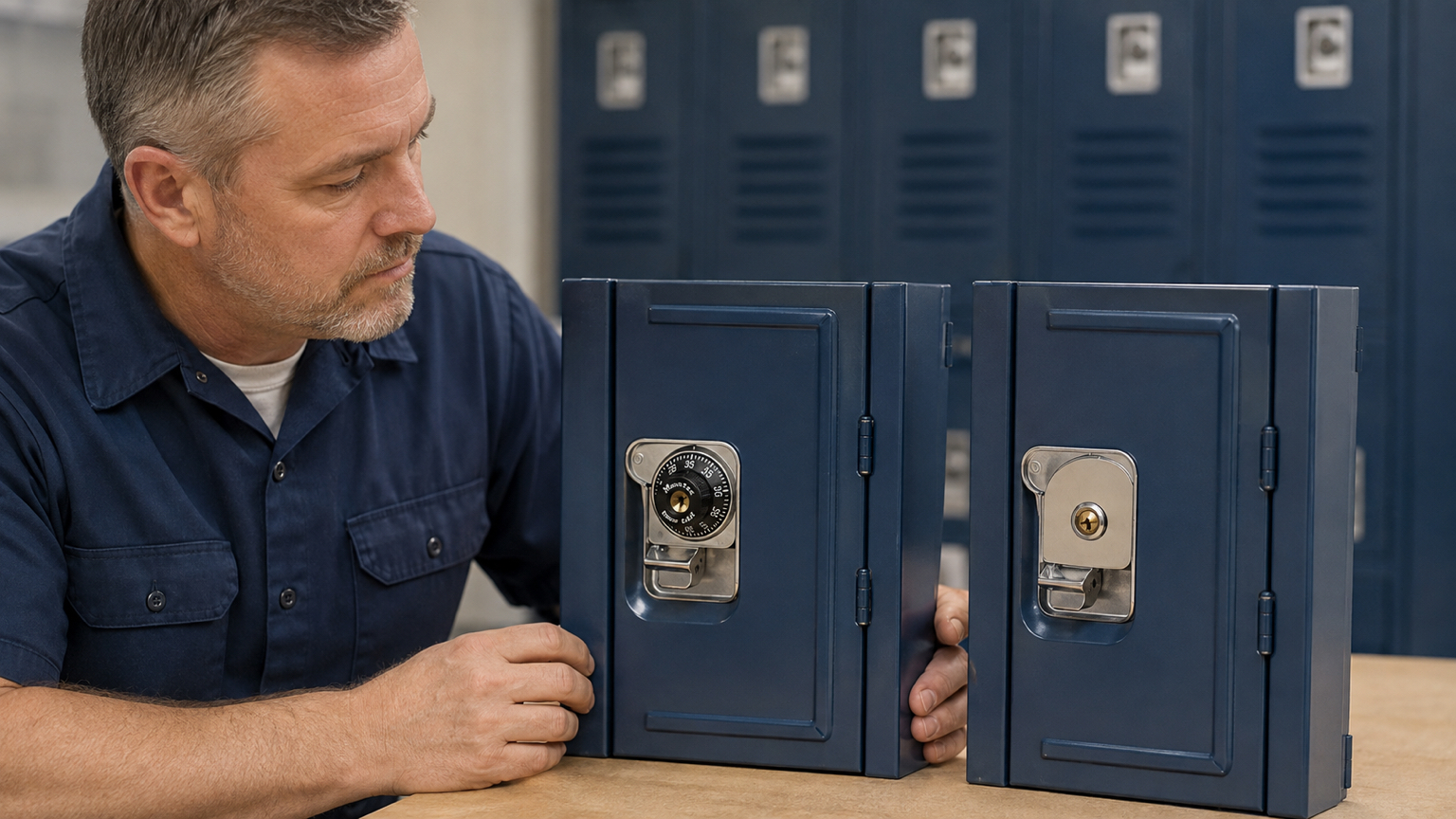
Short answer: the Master Lock 1690 is a built-in combination lock, while the Master Lock 1790 is a built-in keyed lock. Both are documented for compatible right-hinged doors using the manufacturer’s single-point Wrap-Around-Latch™ locker application, but they create different day-to-day access and administration workflows. Choose the lock type only after confirming the locker mechanism, door preparation, handing, and the school’s user and supervisory-access requirements.
Key Takeaways
- The 1690 uses a three-number combination and five manufacturer-provided preset combinations.
- The 1790 is key operated and is offered in manufacturer-defined keying configurations.
- Both models are associated with single-point rotating or Wrap-Around-Latch locker hardware, not every single-point locker.
- Master Lock identifies both models for right-hinged locker doors; neither should be treated as a universal-hand model.
- The current Master Lock product pages identify automatic deadbolt locking for both models.
- The 1690MD is a metal-dial version of the 1690 application; the 1790KA is a keyed-alike version of the 1790 family.
- A model number, latch photographs, door measurements, and existing lock-system information should be reviewed before a school requests replacements.
Master Lock 1690 vs. 1790 Comparison
| Selection factor | Master Lock 1690 | Master Lock 1790 |
|---|---|---|
| User access | Three-number combination | Physical user key |
| Primary application | Single-point rotating or Wrap-Around-Latch locker identified for the 1690 series | Single-point Wrap-Around-Latch locker identified for the 1790 series |
| Manufacturer-listed handing | Right-hinged locker door | Right-hinged locker door |
| Current manufacturer locking description | Automatic deadbolt locking | Automatic deadbolt locking |
| Administration | Preset combinations, control-chart records, and authorized control-key functions | User-key assignment and the selected keyed-different, keyed-alike, master-keyed, or other approved keying plan |
| Related catalog variants | 1690MD metal-dial version | 1790KA keyed-alike version |
| What does not change | The locker and latch still must be compatible; choosing combination or keyed operation does not make an incompatible mechanism fit. | |
The table describes product-family distinctions, not approval for a particular locker. Wrap-around latch geometry, mounting locations, door condition, hinge orientation, and current manufacturer documentation all remain part of the fit decision.
What the Two Models Have in Common
The 1690 and 1790 belong to the same general application family: lockers designed around a single-point rotating latch that wraps around a latch plate. That mechanism is more specific than the phrase “single-point latch.” A locker with a standard horizontal latch may call for another built-in model even if the front of its lock looks similar.
Master Lock describes the wrap-around design as tolerating some locker misalignment, but that is not permission to ignore a bent door, loose hardware, damaged latch plate, or incorrect preparation. Existing problems should be documented and corrected through the appropriate locker-maintenance process. A new lock cannot compensate for every door or frame defect.
The current manufacturer pages identify both models as indoor school, employee, and health-club locker products and describe automatic deadbolt operation. Facilities teams should use the latest product page, current submittal, and locker-manufacturer guidance for the exact configuration being specified, particularly when older project documents use different terminology.
Both Models Are Documented for Right-Hinged Doors
Master Lock’s current 1690 product title identifies a right-hinged application. Its official 1700 Series installation sheet separately states that the 1790 is for a locker door hinged on the right when the door is viewed from the front. The absence of a left- or right-hand suffix on 1790 does not make it a universal-hand lock.
If the existing door is hinged on the left, stop the 1690-versus-1790 comparison and obtain current manufacturer guidance for that locker and access requirement. Do not rotate a lock case, alter a latch, or assume that a related ADA or keyed model has the same handing rules.
Choose the 1690 for Combination-Based User Access
The Master Lock 1690 lets the assigned user operate the locker with a three-number combination. Master Lock identifies five preset combinations and a control-chart system for administration. Those are manufacturer-provided combinations, not a consumer set-your-own code system.
This approach can suit a school that already assigns combinations, maintains restricted combination records, and has an authorized process for supervisory access and periodic reassignment. The selection question is operational as well as mechanical: the school must be prepared to manage the lock records throughout the installation’s life.
The Master Lock 1690MD represents the metal-dial version of this application. The MD designation concerns the dial configuration; it does not turn the lock into a different latch family or remove the need for a compatibility review.
Choose the 1790 for Key-Based User Access
The Master Lock 1790 replaces daily combination entry with a user-key workflow. Master Lock identifies a five-pin tumbler cylinder and several institutional keying approaches. The correct arrangement depends on who should open an individual locker, who needs authorized supervisory access, and whether the order must extend an established key system.
A keyed lock changes the administrative burden rather than eliminating it. Schools need a controlled method for assigning, returning, identifying, and replacing user keys. Key numbers and system records should be treated as restricted operational information. The public article should explain the decision without publishing sensitive system details.
The Master Lock 1790KA is the keyed-alike variant displayed in the School Lock Supply catalog. Keyed alike means the designated locks use the same user key; it is not the same as a master-keyed system in which individual user access and supervisory access are differentiated. Confirm the intended keying structure before requesting a quote.
If the rear mechanism is still uncertain, use the Master Lock 1710, 1714, and 1790 selector. This comparison assumes a confirmed Wrap-Around-Latch application and focuses on combination versus keyed access.
Combination or Keyed: Questions for the School Team
How will students or other users gain access?
A combination model avoids a user key but requires accurate assignment and protected combination records. A keyed model creates a physical-key handoff and return process. Consider the actual population, turnover, training, and support workflow rather than assuming one method is universally easier.
What system is already installed?
An established installation may already have registered combination records, control-key information, or a defined keying plan. Record the exact model and relevant authorized system identifiers. Do not assume a new order can be matched merely because the face of the lock carries the same brand.
Does the locker truly use the wrap-around latch application?
Photograph the latch on the door, the latch plate on the frame, the back of the installed lock, and the full closed-door orientation. If the mechanism cannot be positively identified, start with the replacement school locker lock identification guide.
Information to Gather Before Requesting a Quote
- Current lock manufacturer and complete model designation, including any suffix.
- Locker manufacturer and any available door or series information.
- Clear photographs of the front, rear mechanism, rotating latch, and latch plate.
- Hinge location when facing the closed locker and the measured door thickness.
- Whether the project is a direct replacement, an addition to an existing system, or a new installation.
- Required user-access method and authorized supervisory-access structure.
- Quantity by model or locker bank, with uncertain units separated for review.
Schools comparing more built-in options can review the built-in combination lock category and the built-in keyed lock category. For a deeper look at the combination model’s application, use the Master Lock 1690 wrap-around-latch guide.
Frequently Asked Questions
What is the main difference between the Master Lock 1690 and 1790?
The 1690 is combination operated, while the 1790 is key operated. Both are associated with Master Lock’s right-hinged single-point Wrap-Around-Latch locker application.
Can a 1790 automatically replace a 1690?
No automatic substitution should be assumed. Confirm the specific locker, latch, preparation, handing, administrative system, and current manufacturer guidance before changing lock types.
How do the recordkeeping workflows differ between the 1690 and 1790?
The 1690 requires restricted combination and control-chart records. The 1790 requires user-key assignments and records for the approved keying structure. Each system needs an authorized custody process suited to its credential.
What is the difference between 1690 and 1690MD?
The MD designation identifies a metal-dial version. It does not change the underlying 1690 wrap-around-latch application or replace a fit check.
What does 1790KA mean?
KA identifies a keyed-alike configuration. Designated locks share the same user-key operation, which differs from keyed-different and master-keyed arrangements.
Is every rotating-latch locker compatible with these models?
No. “Rotating latch” is not enough by itself. Confirm that the locker is a right-hinged door designed for the relevant 1690 or 1790 Wrap-Around-Latch family, and review its preparation and condition.
Should a school send key or combination details through a general form?
Provide only the identifiers needed for product matching through an approved business process. Do not place combinations, key cuts, or unrestricted control information in an ordinary inquiry message.
Product References
- Master Lock 1690 product specifications
- Master Lock 1790 product specifications
- Master Lock 1700 Series installation instructions and 1790 handing
- Master Lock architect and locker design resources
- Master Lock locker installation and maintenance resources
Get Help Comparing the 1690 and 1790
If your school is choosing combination or keyed access for a Wrap-Around-Latch locker, ask School Lock Supply for product-selection or quote help. Share the non-sensitive model, latch, door, handing, project, and quantity information needed for an accurate review.