- Empty cart.
- Continue Shopping

Keyed Alike vs. Keyed Different vs. Master Keyed Locker Locks
- Posted on
marketang
- Categories: Locks for School Lockers
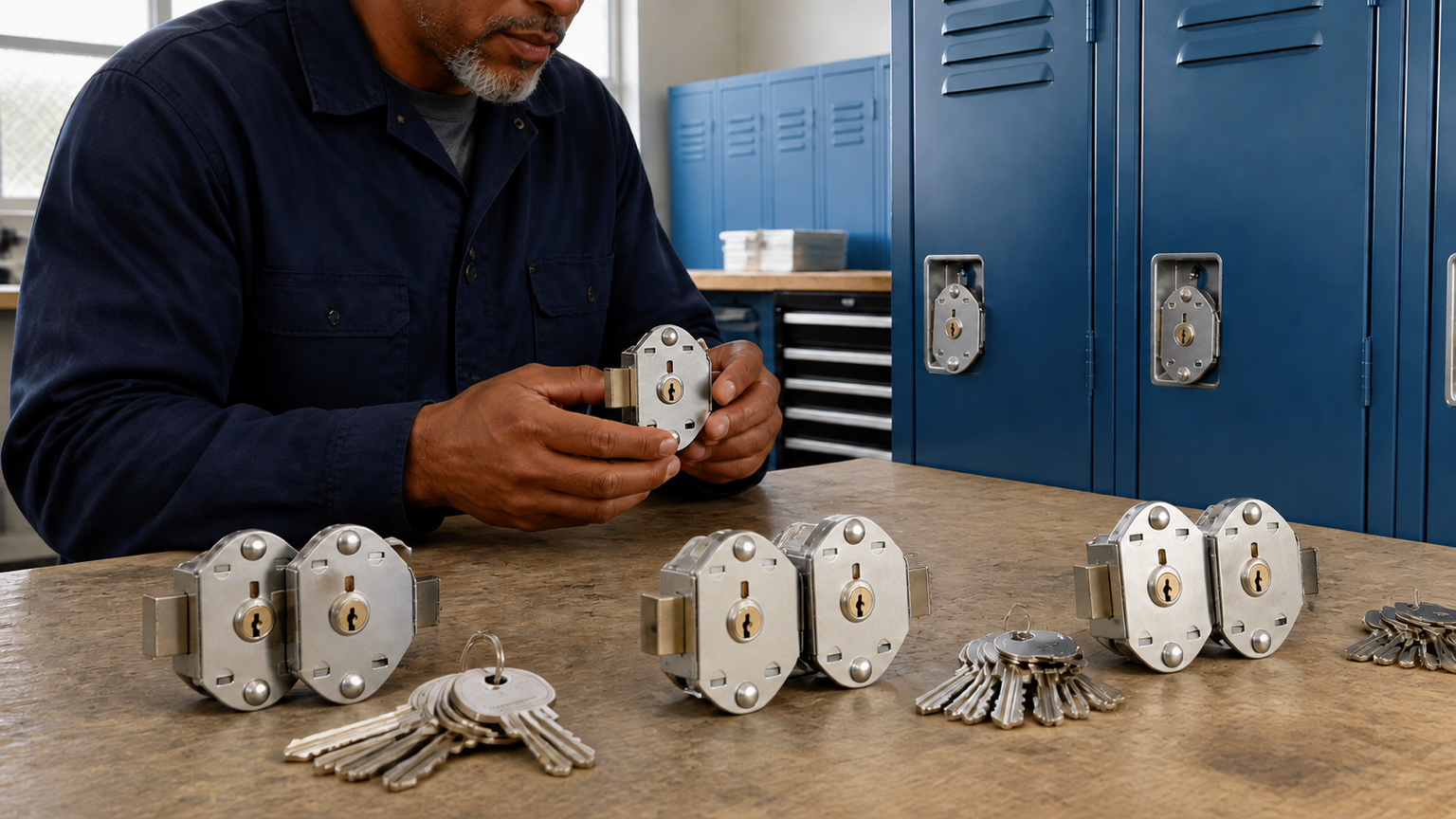
Short answer: keyed different means each locker has its own operating key; keyed alike means one operating key opens every lock in the specified alike system; master keyed means individual operating keys remain distinct while a separate authorized master key opens all locks in that system. Keyed alike is not the same as master keyed. A project can require one property, the other, or a manufacturer-supported combination, so the access plan must be stated explicitly.
Key Takeaways
- Keyed different limits each regular operating key to its assigned lock.
- Keyed alike gives the same regular operating key access to all locks in the defined alike system.
- Master keyed preserves individual operating keys while adding a separate supervisory key for the system.
- A keyed-alike order does not automatically include or imply master-key access.
- Group keyed is a planned access arrangement for a defined group of locks and users, not a synonym for keyed alike.
- Choose the correct physical lock and latch application before selecting the keying structure.
- Require the quote and final key schedule to name every lock configuration, key type, quantity, and authorized access relationship.
Keyed Different, Keyed Alike, Master Keyed, and Group Keyed
| Keying structure | Regular operating-key relationship | Administrative relationship | Typical planning question |
|---|---|---|---|
| Keyed different | Each lock has its own operating key | No system-wide access should be inferred from “keyed different” alone | Should each assigned user operate only one locker? |
| Keyed alike | One operating key opens all locks in the specified alike system | Does not by itself establish a separate master key | Should one regular key operate a defined set of lockers? |
| Master keyed | Each lock retains its own operating key | A separate authorized master key opens all locks within the system | Does administration need supervised system-wide access? |
| Group keyed | Access is arranged for a defined group use case | The group relationship must be documented in the project key schedule | Which people need access to which shared and individual lockers? |
This table explains access relationships, not a lock-selection shortcut. The model, latch, mounting, handing, and door preparation must be compatible before its keying configuration is specified.
Keyed Different Separates Everyday Access
In a keyed-different arrangement, the regular key for one lock does not operate the other keyed-different locks in the system. This is the usual conceptual starting point when lockers are individually assigned and each user should have access only to the corresponding locker.
“Different” describes the regular operating-key relationship. It does not answer whether the locks are also organized under a master-key system. If supervisory access is required, include that requirement separately rather than assuming it is inherent in a keyed-different product description.
Keyed Alike Creates Shared Regular-Key Access
Master Lock defines keyed alike as one key opening all locks in a system. For a defined set of equipment lockers, staff compartments, or other approved shared-use locations, that can reduce the number of regular keys an authorized user carries. It also broadens the effect of each distributed key, because that key operates every lock in the alike set.
Current keyed-alike product pages include the Master Lock 1710KA manual-deadbolt model, the Master Lock 1714KA automatic-springbolt model, and the Master Lock 1790KA rotating Wrap-Around-Latch model. The KA suffix identifies the keying relationship; it does not make these different mechanisms interchangeable.
Keyed Alike Is Not Master Keyed
The distinction is about which kind of key crosses lock boundaries. In a keyed-alike system, the regular operating key is common across the alike locks. In Master Lock’s definition of a master-keyed system, each lock has its own operating key and a separate master key opens all locks within the system.
Some manufacturer-supported configurations may combine keyed-alike and master-keyed properties, but one label never proves the other. An order that says only “KA” should not be treated as a request for a master key. Conversely, a master-key requirement does not mean every user key should be identical.
Group Keyed Is a Deliberate Access Plan
Master Lock presents group keyed as a special locker-lock option and gives the example of four to seven people having access to the same full-length locker as well as their individual box lockers. The important idea is a defined group relationship: access is planned around a subset of users and openings.
For school procurement, handle group keying at the administrative planning level. Identify each group, its shared locker, its individual lockers, and who is authorized to hold each key type. Do not reduce that schedule to “make these alike,” because fully keyed-alike locks create a different access relationship. School policies should govern issuance, storage, recovery, and replacement without publishing sensitive system details.
Choose the Lock Mechanism Before the Keying Option
A keying plan cannot correct a physical mismatch. The 1710 and 1714 are manufacturer-listed for lift-handle, single-point horizontal-latch, and box lockers but differ in manual versus automatic operation. The 1790 is for a single-point rotating Wrap-Around-Latch locker. Use the 1710, 1714, and 1790 selector to establish the mechanism first.
Then confirm handing, mounting pattern, door thickness, alignment, and the locker manufacturer’s compatibility information. A KA suffix changes access, not dimensions or latch action. Schools can review the broader built-in keyed locker lock category after the application is documented.
Build a Quote-Ready Keying Schedule
| Schedule field | What the school should provide | Why it matters |
|---|---|---|
| Opening ID | Building, room, bank, and locker identifier | Connects each access decision to a physical door |
| Lock application | Verified model, latch, handing, and door details | Prevents keying a physically incompatible lock |
| Operating access | Keyed different, keyed alike set, or documented group | Defines regular user access |
| Supervisory access | Whether a manufacturer-supported master-key structure is required | Separates administrative access from regular access |
| Quoted components | Requested locks, operating keys, administrative keys, and installation parts listed separately | Prevents assumptions about package contents |
Manufacturer product-page references should not be used to infer the contents of a School Lock Supply proposal. Have the proposal identify the requested locks and operating keys separately. Master keys, group-access keys, extension parts, and other project items should never be presumed included.
Frequently Asked Questions
What is the difference between keyed alike and keyed different locker locks?
Keyed alike locks share a regular operating key across the defined alike system. With keyed different locks, each lock has its own regular operating key.
Is keyed alike the same as master keyed?
No. Keyed alike makes the regular operating key common. Master keyed keeps individual operating keys while adding a separate authorized master key for the system.
Can locks be both keyed alike and master keyed?
Some current Master Lock product pages list “Master Keyed, Keyed Alike” as a combined keying type. The exact configured product and access relationship must be confirmed for the selected model and documented explicitly in the quote.
What does group keyed mean for school lockers?
It is a planned group-access arrangement. Master Lock’s example lets four to seven people access a shared full-length locker and their individual box lockers. The project schedule should define each group.
Does the KA suffix mean a lock fits a different locker?
No. KA identifies keyed-alike access. The base model’s latch, locking action, handing, mounting, and door requirements still determine physical compatibility.
Are master keys included with keyed-alike locks?
Do not assume so. Keyed alike does not imply master keyed, and administrative keys should be specified and listed separately in the School Lock Supply proposal.
What information should be protected in a school keying plan?
Restrict detailed key schedules, assignments, administrative access records, and authorized system documentation according to school policy. Public-facing materials should explain roles without exposing operational system details.
Continue the Selection Process
If a current lock or latch is uncertain, begin with the replacement school locker lock identification guide. Use a controlled schedule to connect the verified model at each opening with the intended regular, group, and supervisory access.
Product References
- Master Lock keying and custom options
- Master Lock definitions for keyed different, keyed alike, and master keyed
- Master Lock 1710KA current product specifications
- Master Lock 1714KA current product specifications
- Master Lock 1790KA current product specifications
- Master Lock locker installation and terminology guidance
Request the Keying Structure You Actually Need
Ask School Lock Supply for product-selection or quote help. Provide the verified lock applications, opening count, desired keyed-different or keyed-alike relationships, group-access needs, master-key requirements, and a list of components the proposal should identify.