- Empty cart.
- Continue Shopping

How to Choose a Combination Lock for Middle School Lockers
- Posted on
- Categories: Locks for School Lockers

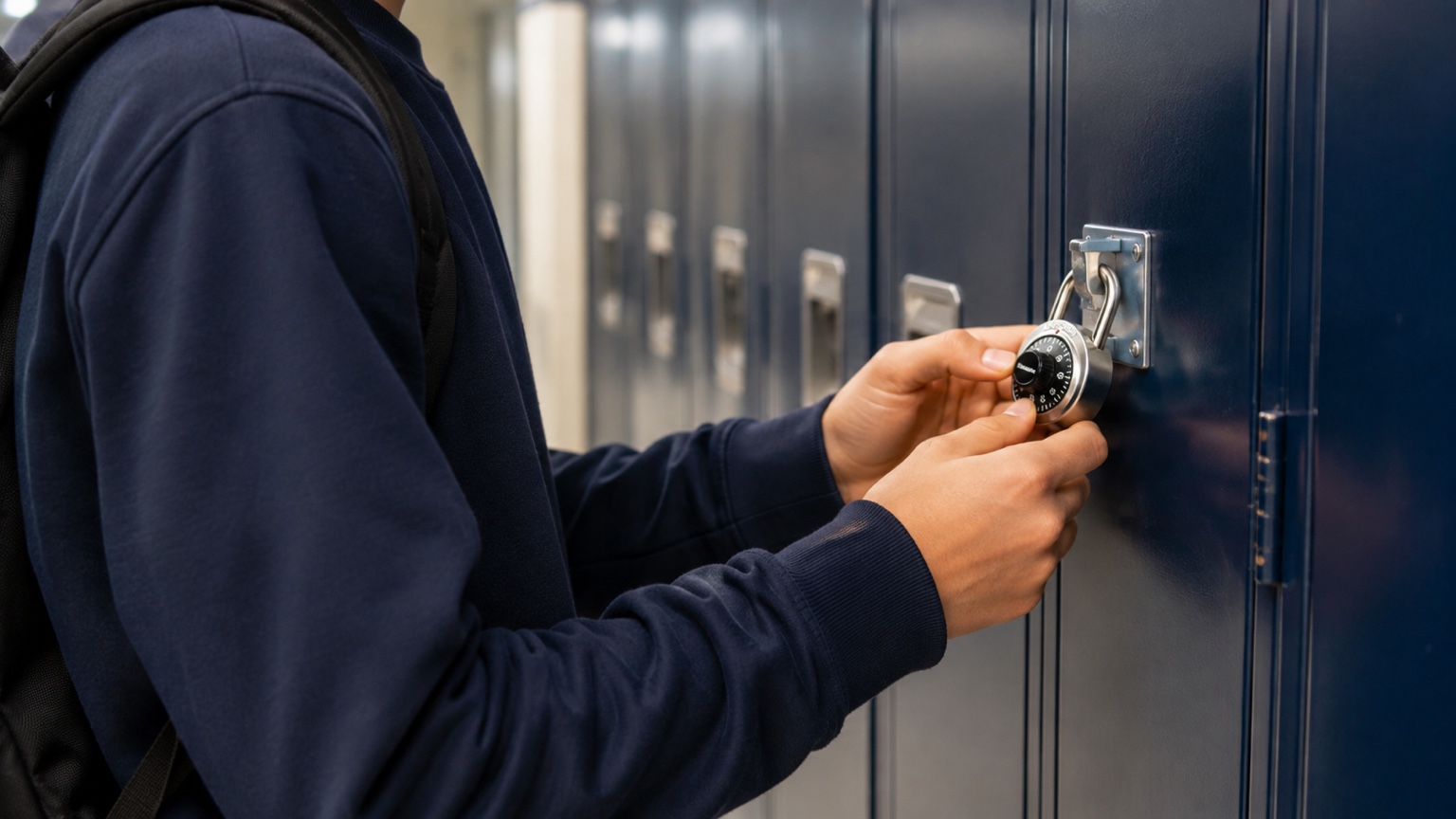
Short answer: there is no universal best combination lock for a middle school locker. Choose by who owns and manages the lock, whether the locker is assigned or shared, the school’s authorized-access process, the student’s ability to operate the selected design, and the actual locker hardware. Confirm fit with measurements and a representative test rather than buying from age labels or appearance alone.
Key Takeaways
- “Middle school” identifies the setting, not one required lock design or security level.
- A school-owned, charted lock supports a different administrative process from a student-owned, set-your-own lock.
- Supervisory key control can support authorized access, but it must match the correct system and school policy.
- A lock must fit the padlock eye, hasp, recessed handle, or built-in latch; shackle length alone cannot prove compatibility.
- Assigned lockers and shared or day-use lockers need different combination-reset, record, and turnover procedures.
- Usability should be evaluated with representative users without relabeling a product as accessible or compliant.
Middle School Combination Lock Selection Checklist
| Decision | Questions to answer | Evidence to collect |
|---|---|---|
| Ownership | School-issued or student-provided? | Written school policy and purchasing responsibility |
| Use pattern | Assigned for a term or shared by multiple users? | Assignment, turnover, and exception workflow |
| Administration | Who records combinations and who may obtain authorized access? | Approved roles and protected-record process |
| Physical fit | Portable padlock eye or built-in latch? What clearance exists? | Photos, dimensions, model markings, representative test |
| Student operation | Can representative students dial, open, close, and secure it reliably? | Supervised pilot and training plan |
| Accessibility | Does the project have a documented accessibility requirement? | Coordinator review and current manufacturer designation |
The checklist keeps “best” from becoming a vague popularity contest. A suitable lock is one whose operation, fit, and administration align with the school’s verified requirements.
Start with School-Owned vs. Student-Owned
School-owned combination locks
A school-owned program can standardize the models issued for compatible locker groups and define how combinations are assigned, protected, recovered, and retired. Institutional preset-combination padlocks such as the Master Lock 1502 and 1525 use an assigned three-number combination rather than a consumer set-your-own format. The Master portable combination lock category is a starting point for reviewing this format.
Standardization does not remove the need for inventory controls. Each lock must remain connected to its identifier and authorized combination record. Schools should limit access to those records and avoid sending combinations through ordinary messages or including them in photographs.
Student-owned combination locks
A student-provided program shifts product selection and day-to-day custody, but the school still needs clear rules. State the permitted lock format, required fit, whether staff must have an authorized access method, what happens after a forgotten code, and when a nonconforming lock may be removed under school policy.
Do not assume a retail package labeled for “school” will fit the campus locker. Provide padlock-eye and clearance guidance where possible, and distinguish a personal set-your-own lock from the school’s charted institutional system.
Decide Whether Supervisory Key Access Is Required
The Master Lock 1502 and 1525 illustrate this choice. Both are institutional combination padlocks with the same published standard body and shackle dimensions. The 1525 adds a supervisory key-control feature; the 1502 does not. The first-cluster 1502 vs. 1525 comparison covers the decision in detail.
Key control should map to a written process. Identify which roles may use authorized access, how credentials are stored, and whether a proposed lock must align with an existing key-control system. A control key is not universal, and an inquiry should not assume that keys, charts, or other items accompany a particular School Lock Supply configuration unless the quote lists them.
Verify Portable-Padlock Fit
For a removable combination padlock, inspect the locker with its hasp or padlock eye in the closed position. Measure the opening, the vertical reach needed by the shackle, the space available for the lock body, and the movement required to insert, close, dial, and remove the lock. Paint buildup, bent eyes, deep recessed cups, and surrounding trim can change the usable space.
Standard, LF, and LH variants in the 1502/1525 families provide different shackle heights. Longer is not automatically better; unused space can permit extra movement or contact with the locker. Use the Master Lock shackle-length guide, then test the exact proposed model on each materially different locker type.
If the existing hardware or model is uncertain, begin with the replacement locker-lock identification guide. A clear full-door photo, padlock-eye close-up, side view, and labeled measurements are more useful than calling the hardware “standard.”
Assigned Lockers vs. Shared or Day-Use Lockers
An assigned locker usually keeps one user-lock relationship for a defined period. The school can issue a lock and record, audit, collect, or reassign it under a consistent schedule. The combination-management workload is predictable because the user changes less often than in a shared program.
A shared or day-use locker requires a deliberate turnover process. The next user must not inherit the prior user’s access, and staff need an approved way to handle abandoned, forgotten, or uncleared use. Do not assume that a lock intended for assigned combinations automatically supports temporary multi-user operation. Confirm the manufacturer’s stated operating mode and create procedures before deployment.
The first-cluster school lock combination-management guide provides a framework for inventory, restricted records, assignments, and year-end reconciliation without publishing bypass or override instructions.
Evaluate Student Usability Without Declaring One Winner
Middle school students do not all have the same dexterity, vision, memory, prior practice, or support needs. Evaluate whether representative users can read and turn the dial, follow the intended sequence, hold the lock in the available space, close it completely, and recognize that it is secured. Provide supervised practice before the lock becomes the only access path to daily materials.
A usability pilot is not an accessibility certification. If a project has documented accessibility requirements, involve the appropriate school or project professional and rely on current manufacturer designations. The ADA-compliant vs. ADA-inspired guide explains why similar marketing phrases should not be treated as interchangeable. After the terminology is clear, the Master Lock ADA locker mechanism selector compares the three manufacturer-designated built-in applications.
A Responsible Pilot Before Wider Use
- Select representative lockers from every hardware group, building, or renovation phase.
- Confirm fit, closing, dialing room, and removal without forcing or altering the hardware.
- Have representative users practice under supervision and record common difficulties without collecting unnecessary personal information.
- Test the school’s approved assignment, forgotten-combination, authorized-access, and return procedures.
- Resolve exceptions before defining the final model and quantity by locker type.
Frequently Asked Questions
What is the best combination lock for a middle school locker?
There is no universal winner. The suitable choice depends on ownership, fit, assigned or shared use, staff-access policy, student operation, and any documented accessibility requirement.
Should a middle school provide locks or ask students to bring them?
That is a school policy and administrative decision. A school-issued program supports standardization and centralized records; a student-provided program needs clear specifications and exception procedures.
Is a set-your-own combination lock the same as an institutional lock?
No. A personal lock may let its user select a code, while institutional models such as the 1502 and 1525 use assigned combinations managed through school records.
Does a school combination lock need supervisory key access?
Not every program does. Decide from written authorized-access procedures. If that path is required, confirm the exact model and registered system rather than assuming one key works broadly.
How can a school tell which shackle length fits?
Measure the closed padlock eye, required reach, body clearance, and operating movement. Choose the shortest shackle that works correctly and verify it on representative lockers.
Can the same combination lock be used for assigned and shared lockers?
Do not assume so. Assigned and temporary multi-user operation require different combination and turnover behavior. Confirm the product’s stated operating mode.
How should students learn to use a new locker lock?
Provide supervised practice with the selected lock and actual locker hardware, plus an approved help process that protects combinations and does not expose access methods publicly.
Product References
- Master Lock 1502 product specifications
- Master Lock 1525 product specifications
- Master Lock locker design resource center
- Master Lock school locker lock support
Get Help Choosing a Middle School Locker Lock
School Lock Supply can help turn the school’s ownership, fit, use-pattern, and authorized-access requirements into a focused set of products to review. Request product-selection or quote help with safe locker photos, measurements, current model information, quantities by hardware group, and a description of the school’s assignment and staff-access process.