- Empty cart.
- Continue Shopping

Master Lock Standard, LF, and LH Shackles: Which Length Fits a School Locker?
- Posted on
marketang
- Categories: Locks for School Lockers
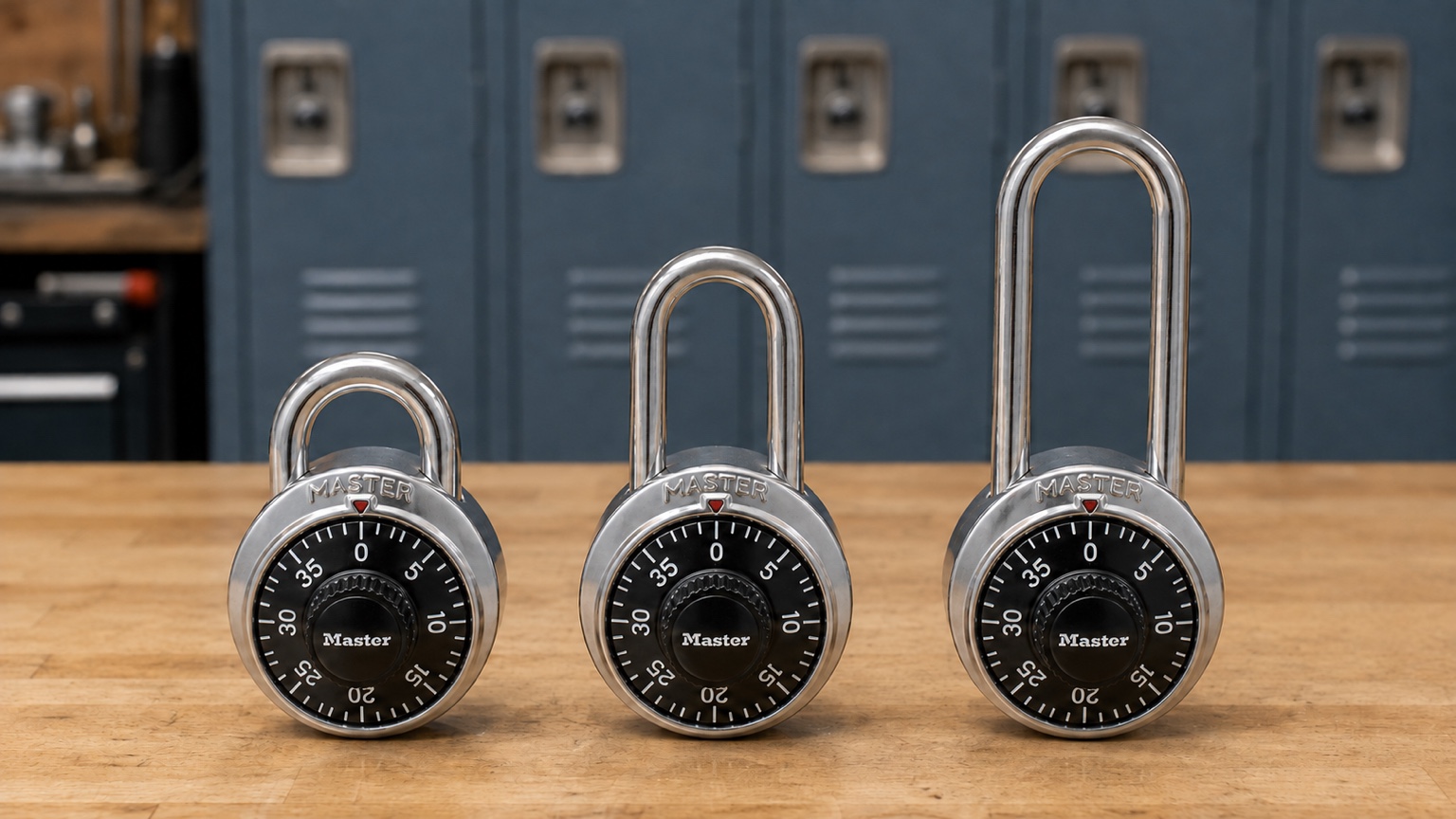
Short answer: standard, LF, and LH identify three shackle-height options on Master Lock 1502 and 1525 school locker padlocks. The standard shackle is 3/4 inch (19 mm), LF is 1-1/2 inches (38 mm), and LH is 2 inches (51 mm). Choose the shortest shackle that fits the measured locker hardware and operates without binding; a longer shackle is not automatically a better fit.
Key Takeaways
- Standard, LF, and LH versions differ in shackle height, not body width, inside shackle width, or shackle diameter.
- Standard is 3/4 inch, LF is 1-1/2 inches, and LH is 2 inches on the 1502 and 1525 families.
- “LH” is a portable-padlock shackle designation here; it does not describe a left-hinged locker door.
- The choice between 1502 and 1525 is separate: the 1525 adds supervisory key control at each shackle length.
- Measure the padlock eye, hasp depth, surrounding clearance, and the movement needed to close and remove the lock before ordering.
Standard, LF, and LH Measurements
| Shackle option | Shackle height | 1502 model | 1525 key-control model | Use as a starting point when |
|---|---|---|---|---|
| Standard | 3/4 in (19 mm) | 1502 | 1525 | The locker eye and handle need minimal reach |
| LF | 1-1/2 in (38 mm) | 1502LF | 1525LF | The standard shackle is too short for measured hardware |
| LH | 2 in (51 mm) | 1502LH | 1525LH | The application demonstrably requires the most clearance |
The dimensions are selection guidance, not a promise that a particular model will fit every locker. Confirm the full hardware geometry and test the selected configuration on representative doors.
What Changes—and What Stays the Same
Within the Master Lock 1502 and 1525 families, the suffix changes shackle height. The body remains 1-7/8 inches (48 mm) wide, the inside shackle width remains 13/16 inch (21 mm), and the shackle diameter remains 9/32 inch (7 mm). Master Lock specifies a locker padlock eye at least 5/16 inch (8 mm) in diameter.
That consistency helps a facilities team compare reach without assuming that a longer model is larger in every direction. It also highlights a common fit problem: extra vertical height cannot solve a padlock eye that is too small, an obstruction beside the eye, or inadequate clearance for the lock body.
All six models are institutional preset-combination padlocks with a 40-number dial. Master Lock lists automatic scrambling, BlockGuard® Anti-Shim Technology, a hardened steel shackle, a double-reinforced stainless steel body, and combination-chart administration across the two families. Schools can compare them together in the Master portable combination lock collection.
What LF and LH Mean in This Comparison
For these portable-padlock model numbers, LF and LH identify published shackle variants. Use the model number and stated measurement rather than inventing a phrase for either suffix. The reliable purchasing information is simple: LF has a 1-1/2-inch shackle, while LH has a 2-inch shackle.
Also avoid confusing the “LH” suffix with locker-door orientation. Built-in locker locks may be selected for right- or left-hinged doors, but the LH in a portable model such as 1502LH or 1525LH refers to its shackle configuration. A school still needs to evaluate the actual hasp or padlock eye regardless of which side the door hinges are on.
Why More Shackle Clearance Is Not Always Better
A longer shackle may be necessary when the padlock eye sits behind a deep handle or when the hardware requires more vertical reach. But unused clearance gives the padlock more room to move. It may let the body contact the locker finish or create an awkward position for dialing and closing.
The goal is not to maximize open space. It is to find the shortest option that passes through the intended eye, closes completely, leaves enough room for normal operation, and can be removed without twisting against nearby hardware. Choosing from measurements also reduces the temptation to solve a mismatch by forcing the lock or modifying the locker.
How to Measure a School Locker for a Portable Padlock
1. Inspect the complete locking path
Open and close the locker and observe how the handle, hasp, padlock eye, and latch move. Photograph the hardware from the front and side. Record any visible locker manufacturer or model information, because visually similar handles can have different depths.
2. Check the padlock-eye opening
Confirm that the opening can accept the published 9/32-inch shackle diameter and compare it with Master Lock’s stated minimum 5/16-inch padlock-eye diameter. Inspect for bent, damaged, painted-over, or obstructed hardware that could distort a measurement.
3. Measure required shackle reach
Measure the clearance from the padlock eye to any surface the curved top of the shackle must pass around. Account for the movement needed to insert, rotate, close, and remove the lock. A static front-view measurement alone may miss an obstruction behind the handle.
4. Confirm room for the lock body
The shackle may fit while the 1-7/8-inch body interferes with a recessed cup, adjacent trim, or another part of the handle. Make sure the dial remains reachable and the lock can hang without binding.
5. Test representative lockers
For a campus or district deployment, group lockers by hardware type and test the exact proposed model on each group. Do not assume one sample represents buildings installed or renovated at different times.
Shackle Length and Supervisory Key Control Are Separate Choices
The 1502 family does not provide supervisory key control. The 1525 family adds a control-key feature, and that feature is available with standard, LF, and LH shackles. Select the administrative model first or alongside the physical fit—not instead of it.
If staff need key access, document the school’s existing registered system and authorized key holders. Control keys are system-specific, not universal. Ask that locks, keys, combination charts, and other requested items be identified clearly when reviewing a quote.
Frequently Asked Questions
How long is a standard Master Lock school padlock shackle?
On the 1502 and 1525 models discussed here, the standard shackle height is 3/4 inch (19 mm). Suffix conventions can differ across product families, so verify the exact model’s specifications.
What is the shackle height of a 1502LF or 1525LF?
Both LF variants have a published shackle height of 1-1/2 inches (38 mm). The difference between them is supervisory key control: the 1525LF has it; the 1502LF does not.
What is the shackle height of a 1502LH or 1525LH?
Both LH variants have a 2-inch (51 mm) shackle. Choose one only when measurements show that the application needs that clearance.
Does LH mean the lock is for a left-hinged locker?
No. In these portable-padlock model numbers, LH identifies the 2-inch shackle option. It is not a left-hand locker-door designation.
Do longer shackles use a wider or thicker lock body?
Not in these two families. Master Lock publishes the same 1-7/8-inch body width, 13/16-inch inside shackle width, and 9/32-inch shackle diameter for the standard, LF, and LH versions.
Should a school automatically order the longest shackle?
No. Select the shortest shackle that fits and operates correctly. Extra height may allow unwanted movement or contact with the locker, while failing to solve other geometry problems.
Continue the Selection Process
After confirming clearance, use the Master Lock 1502 vs. 1525 comparison to decide whether supervisory key control is required. For unknown existing hardware, start with the replacement school locker lock identification guide.
Product References
- Master Lock 1502 standard-shackle specifications
- Master Lock 1502LF specifications and Master Lock 1502LH specifications
- Master Lock 1525 standard-shackle specifications
- Master Lock 1525LF specifications and Master Lock 1525LH specifications
Get Help Matching the Shackle to Your Locker
School Lock Supply can help translate locker measurements and staff-access requirements into a specific model to review. Request product-selection or quote help with photos, padlock-eye and clearance measurements, existing lock model numbers, and the quantity needed for each locker-hardware type.