- Empty cart.
- Continue Shopping

Master Lock 2002 vs. 2010: Which High-Security Locker Padlock Fits Your School?
- Posted on
marketang
- Categories: Locks for School Lockers
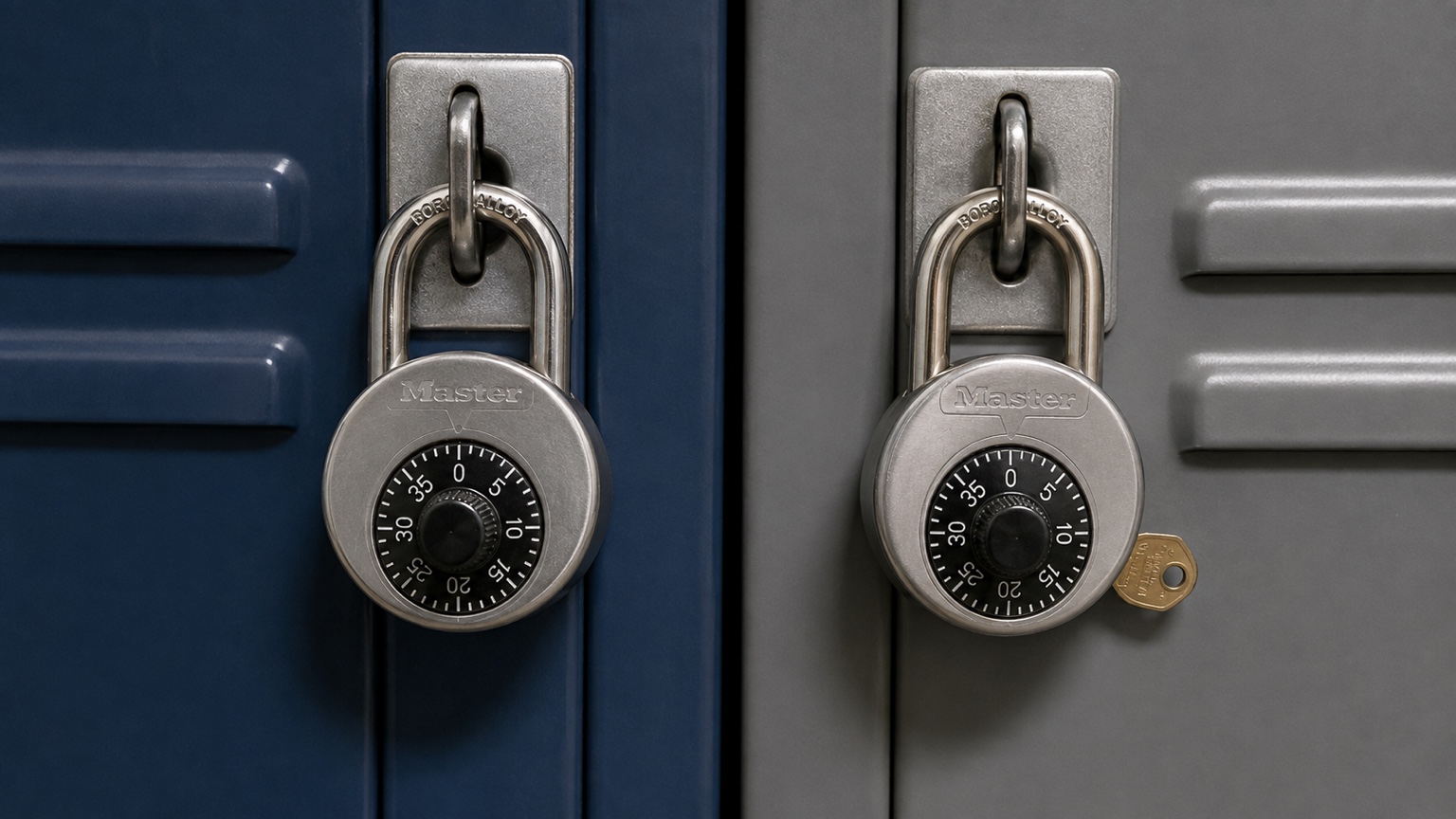
Short answer: choose the Master Lock 2002 when a school needs a high-security, preset-combination locker padlock without supervisory key access. Choose the Master Lock 2010 when authorized staff also need to open the padlock with the correct control key. Their standard dimensions and core security construction are closely matched, so the deciding issue is usually administrative access rather than size.
Key Takeaways
- The Master Lock 2002 and 2010 are high-security, three-number combination padlocks intended for institutional locker programs.
- The 2010 adds a backside key cylinder for supervisory access; the 2002 does not have that feature.
- Both standard models use a 1-inch (25 mm) shackle, while the 2002S and 2010S use a 1/2-inch (13 mm) short shackle.
- Both families use a recessed dial, reinforced case, hardened boron-alloy shackle, automatic scrambling, and dual-ball-bearing locking.
- Before ordering, confirm locker-hardware clearance, the school’s staff-access policy, and whether a new 2010 must align with an existing registered key system.
Master Lock 2002 vs. 2010 at a Glance
| Decision point | Master Lock 2002 | Master Lock 2010 |
|---|---|---|
| Student operation | Preset three-number combination | Preset three-number combination |
| Supervisory key access | No | Yes, through a backside key-control cylinder |
| Standard shackle height | 1 in (25 mm) | 1 in (25 mm) |
| Short-shackle counterpart | 2002S: 1/2 in (13 mm) | 2010S: 1/2 in (13 mm), with key control |
| Standard body width | 2-3/16 in (56 mm) | 2-3/16 in (56 mm) |
| Best starting point | Combination-only administration | Combination use plus authorized staff override |
This comparison narrows the choice, but it does not replace a fit check. Measure the actual locker hardware and confirm the requested lock and key-system configuration before a school-wide order.
What the Master Lock 2002 and 2010 Share
Both models are built around the same high-security institutional concept. Master Lock specifies a fully recessed dial, a double-armored stainless steel case, dual-ball-bearing locking, and a hardened boron-alloy shackle. The recessed dial and reinforced case distinguish these models from lighter-duty school combination padlocks, while automatic scrambling changes the dial position when the shackle closes.
Each lock uses a 40-number dial and a preset three-number combination. The school receives combination-chart information for administration; these are not ordinary consumer padlocks on which each student selects a personal code. Treat the combination chart as controlled operational information and decide which staff roles may access it.
The standard 2002 and 2010 also share the same published dimensions: a 2-3/16-inch (56 mm) body, 1-inch (25 mm) shackle height, 15/16-inch (24 mm) inside shackle width, and 5/16-inch (8 mm) shackle diameter. Master Lock calls for a padlock eye at least 11/32 inch (9 mm) in diameter. The high-security combination lock collection provides a useful place to compare the related configurations.
The Main Difference Is Supervisory Key Access
Choose the 2002 for combination-only operation
The Master Lock 2002 opens with its assigned combination and does not include the 2010’s supervisory key-control cylinder. That makes it the more direct choice when a school’s established policy relies on combination records and does not require staff to open the padlock by key.
“No key control” should be an intentional administrative decision, not an assumption made from a similar-looking lock. Before standardizing on the 2002, confirm how staff handle forgotten combinations, reassigned lockers, end-of-term collection, and urgent access under school policy.
Choose the 2010 when authorized staff need a key path
The Master Lock 2010 adds a key-control cylinder on the back of the lock. With the correct authorized control key, designated staff can open the padlock without using the assigned combination. The student-facing combination operation remains familiar; the added access path is for administration.
Control keys are not universal. A district adding locks to an existing registered system should provide the relevant system information through an authorized purchasing process. It should also identify how many control keys are required, who will hold them, and how issuance will be recorded. Do not assume that a lock quote automatically includes keys, charts, or other accessories; ask for each requested item to be identified.
Standard vs. Short Shackles
The standard 2002 and 2010 each have a 1-inch shackle. Their short-shackle counterparts—the 2002S and 2010S—reduce shackle height to 1/2 inch. The 2010S keeps the supervisory key-control feature, while the 2002S remains the combination-only option.
Master Lock positions the short versions for recessed-handle locker doors. That does not mean every recessed handle requires an “S” model or that every surface-mounted hasp requires the standard version. Hasp depth, eye location, surrounding trim, and the motion needed to close and remove the lock all affect fit.
Use the shortest shackle that allows the selected padlock to pass through the eye, close fully, and operate without binding. Do not alter locker hardware or force a lock that lacks clearance. For a large deployment, test the exact proposed configuration on each materially different locker type represented on campus.
A Practical Selection Process for School Facilities Teams
- Identify the locker hardware. Record the manufacturer or visible model information and take clear photos of the hasp, handle, and padlock eye.
- Measure the application. Check the padlock-eye opening and the vertical and horizontal clearance needed for the shackle and lock body.
- Decide whether key override is required. Map the choice to written staff-access procedures rather than choosing by appearance.
- Document an existing key system. If the campus already uses supervised key control, confirm the registered system details through the appropriate administrator.
- Select standard or short shackle. Compare the 1-inch and 1/2-inch options against the measured locker, then verify operation with a sample when practical.
- Define the requested package. List lock quantities, model variants, control keys, combination records, and any required identification options separately.
This process is especially important in districts with lockers from different renovation periods. A model that fits one building may not fit another even when both doors look similar from the hallway.
Frequently Asked Questions
What is the biggest difference between the Master Lock 2002 and 2010?
The 2010 has a backside key-control cylinder for authorized supervisory access. The 2002 is opened by its assigned combination and does not include that key-control feature.
Are the standard 2002 and 2010 the same size?
Yes, their published standard dimensions match: a 2-3/16-inch body, 1-inch shackle height, 15/16-inch inside shackle width, and 5/16-inch shackle diameter. Actual locker fit still needs to be verified.
Can students choose their own combinations on these locks?
No. These institutional models use preset, charted three-number combinations rather than a consumer set-your-own-combination mechanism.
What are the Master Lock 2002S and 2010S?
They are short-shackle versions with a 1/2-inch shackle. The 2002S is combination-only; the 2010S retains supervisory key control. Master Lock associates the short format with recessed-handle locker applications.
Does one control key open every Master Lock 2010?
No. Supervisory key access depends on the correct registered key system. A school should verify its existing system and requested keying rather than treating a control key as universal.
How can a school confirm which model will fit?
Measure the padlock eye and operating clearance, compare those measurements with the manufacturer’s dimensions, and test the exact model and shackle variant on representative locker hardware before a broad rollout.
Continue the Selection Process
The standard and short 2002/2010 choices are specific to this high-security family. For the standard, LF, and LH options used by 1502/1525 locks, see the separate Master Lock shackle-length guide. Schools preparing quantities and system details can use the bulk locker-lock pre-quote checklist.
Product References
- Master Lock 2000 Series portable combination lock specifications
- Master Lock 2002 technical guide
- Master Lock 2010 product specifications
Get Help Choosing a High-Security Locker Padlock
School Lock Supply can help organize the model, shackle, fit, and key-control questions for your project. Request product-selection or quote help and include photos of the locker hardware, relevant measurements, quantities, and any existing key-system information your school is authorized to share.