- Empty cart.
- Continue Shopping

Short-Shackle Locks for School Lockers: 2002S, 2010S, and Fit
- Posted on
- Categories: Locks for School Lockers

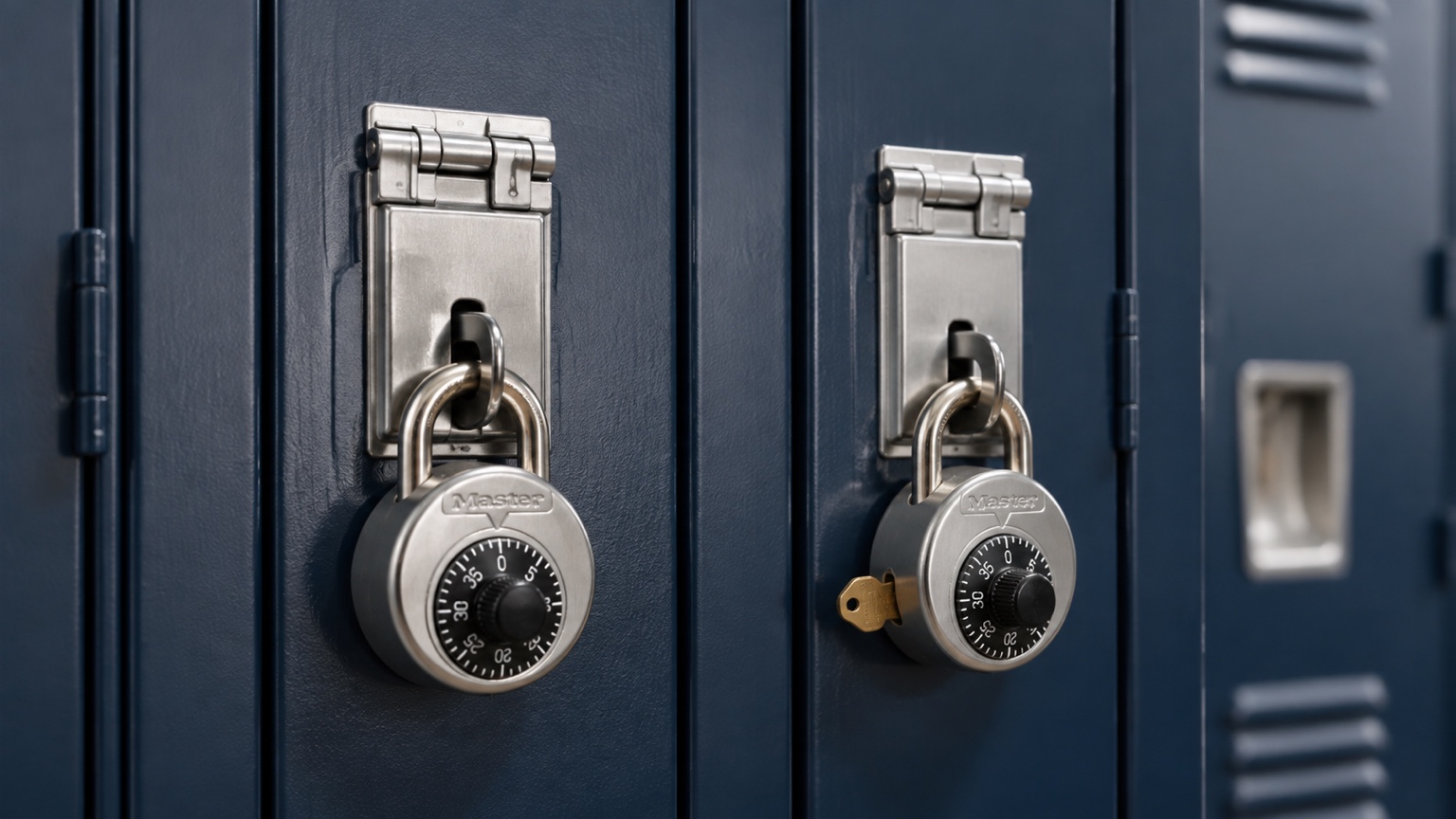
Short answer: a short-shackle lock reduces the open height of the U-shaped metal loop that passes through the locker hardware. The Master Lock 2002S and 2010S were both specified with a 1/2-inch (13 mm) shackle; the key difference is that the 2010S adds supervisory key access. Master Lock’s current 2010S page says discontinued. The 2002S has conflicting manufacturer signals, so confirm its current commercial status and any proposed alternative before planning an order.
Key Takeaways
- People often search for a “short shank lock,” but the correct name for the curved locking component is the shackle.
- The 2002S and 2010S have the same published 1/2-inch shackle height, 5/16-inch diameter, 15/16-inch inside width, and 2-3/16-inch body width.
- The 2002S is combination-only; the 2010S provides a supervisory key-control path when used with the correct authorized system.
- Master Lock associated the short-shackle versions with recessed-handle locker applications, but that description does not establish universal fit.
- Current manufacturer status must be checked: Master Lock marks the 2010S discontinued, while its 2002S references are inconsistent across current and older official material.
“Short Shank” vs. “Short Shackle”
A padlock shackle is the curved metal loop that opens, passes through a hasp or padlock eye, and locks back into the body. Master Lock measures shackle length from the top of the lock body to the inside of the shackle. “Shank” is understandable search language, but it is not the manufacturer’s name for this component.
Using the correct term helps when reading a drawing, measuring a locker, or requesting product guidance. It also prevents confusion with shackle diameter and inside width. A short shackle changes vertical clearance; it does not make an undersized padlock eye larger or remove an obstruction beside the handle.
Master Lock 2002S vs. 2010S
| Decision point | Master Lock 2002S | Master Lock 2010S |
|---|---|---|
| User operation | Preset three-number combination | Preset three-number combination |
| Supervisory key access | No | Yes, with the correct authorized key system |
| Shackle height | 1/2 in (13 mm) | 1/2 in (13 mm) |
| Inside shackle width | 15/16 in (24 mm) | 15/16 in (24 mm) |
| Shackle diameter | 5/16 in (8 mm) | 5/16 in (8 mm) |
| Body width | 2-3/16 in (56 mm) | 2-3/16 in (56 mm) |
| Current manufacturer signal | A 2021 official index lists it as discontinued, but current Master Lock material still references the model | Current product page says discontinued |
The dimensional comparison is useful for identification, but it is not a statement that either model can currently be supplied. Master Lock’s dedicated 2002S product URL now redirects to search; a manufacturer index effective in 2021 places the 2002S in its discontinued section, while the current 2010 page and current-hosted technical material still name the 2002S. The School Lock Supply 2002S reference page and 2010S reference page can help frame an inquiry, but live reference pages alone do not establish manufacturer status or supply.
What the Two Short-Shackle Models Share
Master Lock’s 2000 Series specification groups the 2002S and 2010S as high-security portable combination padlocks. It describes a double-reinforced stainless steel outer case, die-cast zinc inner case, fully recessed dial, hardened boron-alloy shackle, and dual deadbolt locking mechanism. The locks use a three-number combination selected from a 40-number dial and automatically scramble when closed.
The same specification calls for a locker padlock eye with a minimum diameter of 11/32 inch (9 mm). That value addresses the opening through which the 5/16-inch shackle must pass. It does not describe the full space required to insert, rotate, close, dial, and remove the lock around a recessed handle.
These short models belong to the same dimensional family as the standard-shackle 2002 and 2010, which use a 1-inch shackle. The first-cluster Master Lock 2002 vs. 2010 guide explains the broader combination-only versus supervisory-access decision. If the project has not yet separated portable from built-in hardware, begin with the school locker lock types guide. The high-security combination lock category provides the relevant School Lock Supply inquiry path.
The Meaningful Difference: Supervisory Access
The 2002S relies on its assigned combination for opening. The 2010S adds a cylinder on the back for supervisory access through the correct authorized key-control system. That is an administrative distinction, not a dimensional one: the published body and shackle measurements match.
A school identifying an existing 2010S installation should document its authorized system reference without exposing keys, combinations, or unrestricted records. A key specified for one key-control arrangement should not be treated as universal. When asking about a replacement or successor, state whether preserving an established supervisory-access process is required.
How to Check Short-Shackle Fit
- Identify the existing hardware. Photograph the closed locker, recessed handle, padlock eye, and any readable lock markings. Do not include visible combinations or student information.
- Measure the eye. Check the opening the shackle must pass through and compare it with the manufacturer’s published dimensions.
- Measure operating clearance. Account for the movement needed to insert the shackle, rotate the body, close the lock, use the dial, and remove it.
- Inspect surrounding surfaces. A short shackle may suit a recessed pocket while the larger lock body still contacts trim or prevents comfortable dialing.
- Test representative lockers. Buildings and renovation phases may use different handles. Verify the exact proposed current model on every materially different hardware group.
Choose by the whole geometry, not by the phrase “recessed handle” alone. A short shackle that cannot swing into place is too short, while unused clearance can allow extra movement. Never force a lock, grind the shackle, or alter school hardware merely to make a model appear to fit.
What to Include in a Short-Shackle Status Inquiry
Separate identification from the replacement decision. State whether the school is documenting an installed 2002S or 2010S, replacing damaged units, adding locks to an older system, or evaluating a different current configuration. Include the quantity for each situation rather than combining unlike needs into one total.
Provide clear photographs of the lock face, back of the lock, closed locker handle, padlock eye, and any safe-to-share model markings. Add labeled measurements for the eye opening, recessed-pocket depth, and available movement. For a 2010S system, say whether supervisory access must be preserved, but do not place combinations, unrestricted control records, key images, or student information in an ordinary inquiry. Ask the supplier to confirm the product status, proposed model, fit assumptions, and any information still needed before the school relies on a recommendation.
Frequently Asked Questions
Is a short shank lock the same as a short-shackle lock?
Searchers commonly use both phrases, but “shackle” is the correct padlock term. It is the curved metal loop that passes through the locker’s padlock eye or hasp.
How long is the shackle on the Master Lock 2002S and 2010S?
Master Lock publishes a 1/2-inch (13 mm) shackle height for both models. It also lists a 15/16-inch inside width and 5/16-inch diameter.
What is the main difference between the 2002S and 2010S?
The 2010S supports supervisory key access through the correct authorized system. The 2002S is the combination-only version of the short-shackle design.
Are the 2002S and 2010S current Master Lock products?
Master Lock’s current 2010S page labels that model discontinued. For the 2002S, an official 2021 index says discontinued, but current manufacturer material still references it. Ask for written confirmation rather than assuming current supply.
Does every recessed-handle locker need a short shackle?
No. Recessed hardware is a reason to investigate the short format, not proof of fit. Eye size, pocket depth, body clearance, and operating movement all need review.
Can a standard 2002 or 2010 replace an S model?
Do not assume so. The standard models use a 1-inch shackle rather than the S models’ 1/2-inch shackle. Compare the measured application and current manufacturer guidance.
Product References
- Master Lock 2010S product page and current status
- Master Lock July 2021 price-list index placing the 2002S in its discontinued section
- Current Master Lock 2010 page still referencing the 2002S short-shackle model
- Master Lock 2000 Series portable combination padlock specification
- Master Lock locker catalog with 2002S and 2010S dimensional drawing
- Master Lock guidance on shackle terminology and measurement
Ask About a Short-Shackle Locker Application
School Lock Supply can review the model-identification, fit, and supervisory-access questions for an existing locker program. Request product-selection or quote help with safe photos, padlock-eye and operating-clearance measurements, existing model information, quantities by hardware type, and whether authorized staff access must be preserved.